

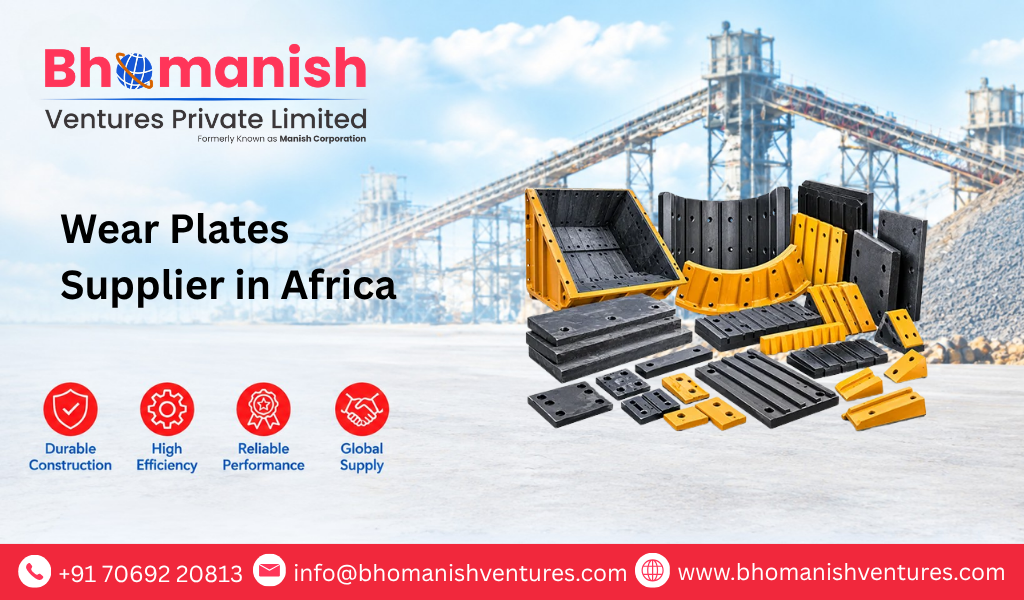
Wear Plates Supplier in Africa
Industries operating in mining, construction, cement, quarrying, material handling, and heavy engineering often work with abrasive materials that can rapidly wear down conventional steel surfaces. For such applications, selecting the right Wear Plates Supplier in Africa is important for protecting equipment surfaces, reducing unplanned maintenance, and maintaining dependable operating performance. Buyers generally look for suitable plate grades, dimensions, application guidance, consistent quality, and reliable supply rather than choosing a plate only by price.
Bhomanish Ventures Private Limited supports industrial buyers seeking wear-resistant plate solutions for demanding applications. When evaluating Wear Plates in Africa, purchasers should consider the type of abrasion, impact conditions, operating environment, plate thickness, fabrication requirements, and compatibility with the equipment being protected.
What Are Wear Plates and How Do They Work?
Wear plates are steel plates designed to provide a more abrasion-resistant surface in equipment exposed to material movement, sliding, impact, or repeated contact. They are commonly incorporated into areas where ordinary structural steel may experience significant surface deterioration.
The basic purpose is straightforward: instead of allowing the primary equipment structure to absorb continuous abrasive action, a wear-resistant plate provides a protective working surface. Depending on the application, plates may be used in chutes, hoppers, bins, liners, conveyor-related equipment, crushers, feeders, and other industrial systems.
For buyers comparing a Wear Plates Manufacturer or Wear Plates Supplier, it is important to understand that the appropriate product depends on the actual service conditions. A plate suitable for sliding abrasion may not necessarily be the right choice for severe impact or a different operating environment.
Material and Technical Considerations
Before placing an order, buyers should provide practical information about the equipment and working conditions. Important considerations include:
- Type and severity of abrasion
- Presence of impact or shock loading
- Material being processed
- Plate thickness and required dimensions
- Fabrication, cutting, drilling, or welding requirements
- Operating temperature and surrounding environment
- Installation method and available space
- Expected maintenance and replacement conditions
A reliable Wear Plates Supplier should be able to discuss these requirements rather than recommending a generic product without understanding its application.
Buyers should also distinguish between hardness, toughness, weldability, and overall service suitability. A higher hardness value alone does not automatically make a plate suitable for every industrial situation. Application conditions and fabrication requirements must be considered together.
Key Features and Benefits for Heavy-Duty Applications
The main purpose of wear plates is to protect equipment from premature surface deterioration. Depending on the selected material and application, they can provide several practical advantages:
- Improved resistance to abrasive wear
- Protection of underlying equipment structures
- Potentially longer intervals between replacement activities
- Suitability for demanding material-handling environments
- Better protection of high-wear zones
- Reduced need for frequent structural repairs
For businesses searching for a Top Wear Plates Supplier in Africa or Best Wear Plates Supplier in Africa, product suitability and supply consistency should be examined alongside commercial considerations. Documentation, dimensional accuracy, material identification, and communication about application requirements can all be important during procurement.
Industry-Wise Applications
Wear-resistant plates are used across numerous industries where abrasive materials can affect equipment surfaces.
Mining: Chutes, hoppers, transfer points, bins, and material-handling equipment may experience continuous contact with ore, rock, and other abrasive materials.
Cement and construction: Processing and conveying systems can require protection in areas exposed to aggregates, clinker, cement-related materials, and other abrasive substances.
Quarrying: Equipment handling stone and aggregates can encounter significant sliding and impact wear.
Material handling: Industrial plants may use protective plates in hoppers, feeders, transfer systems, and other high-contact areas.
Recycling and processing: Equipment handling mixed or abrasive materials may require wear protection in selected working zones.
The exact plate selection should always reflect the material, operating conditions, equipment design, and expected wear mechanism.
Common Buyer Problems and Requirements
Industrial buyers looking for Wear Plates Supplier Near me often want more than a nearby source. They may need assistance with dimensions, material selection, quantity planning, documentation, delivery coordination, or replacement requirements.
Another common issue is purchasing a plate based solely on its initial price. The lowest purchase price may not represent the most suitable option if the plate does not match the actual application.
Before requesting a quotation, buyers should ideally provide:
- Required plate dimensions and thickness.
- Equipment or application details.
- Quantity required.
- Material being processed.
- Wear or operating conditions.
- Cutting, drilling, or fabrication requirements.
- Delivery destination and required schedule.
For buyers planning to Buy Wear Plates in Africa, these details can make the quotation and product-selection process more efficient.
How to Select and Buy Wear Plates
When comparing Wear Plates Price in Africa, avoid comparing quotations solely on the price per plate. Check the material specification, dimensions, quantity, fabrication requirements, documentation, packaging, freight considerations, and other applicable commercial terms.
Businesses looking to Buy Wear Plates for Sale in Africa should also confirm whether the supplier can support the required plate format and application. If the material will be cut or fabricated before installation, the buyer should communicate those requirements before ordering.
For international procurement, buyers evaluating a Wear Plates Supplier & Exporter in Africa should clarify delivery terms, packaging, documentation, destination requirements, and responsibilities for transportation. Export arrangements should be confirmed for the specific order rather than assumed from a general supplier description.
Bhomanish Ventures Private Limited can be considered by industrial buyers seeking structured communication around wear-plate requirements, application needs, and procurement specifications.
FAQs About Wear Plates
1. What are wear plates mainly used for?
Wear plates are primarily used to protect equipment surfaces exposed to abrasion, sliding contact, and, depending on the product, impact conditions.
2. How do I choose the right wear plate?
Consider the material being handled, abrasion level, impact conditions, dimensions, thickness, fabrication requirements, and operating environment.
3. Can wear plates be used in mining equipment?
Yes. Mining and mineral-processing equipment can use wear plates in areas such as chutes, hoppers, bins, and other material-contact zones, subject to application requirements.
4. Should I select a wear plate only by hardness?
No. Hardness is only one consideration. Toughness, fabrication requirements, wear mechanism, and operating conditions can also affect product suitability.
5. What information should I give a supplier before buying?
Provide dimensions, thickness, quantity, application, material being handled, operating conditions, and any cutting or fabrication requirements.
6. How should I compare Wear Plates Price in Africa?
Compare the complete commercial offer, including material specification, dimensions, quantity, fabrication, documentation, delivery, and applicable logistics—not simply the base plate price.
7. Can wear plates be supplied for different industrial applications?
Yes, but the appropriate product should be selected according to the specific operating and wear conditions of each application.
Tags : Wear Plates Supplier in Africa, Top Wear Plates Supplier in Africa, Best Wear Plates Supplier in Africa, Wear Plates Supplier, Wear Plates Manufacturer, Wear Plates Supplier Near me, Wear Plates in Africa, Wear Plates Supplier & Exporter in Africa, Wear Plates Price in Africa, Buy Wear Plates in Africa, Buy Wear Plates for Sale in Africa, Wear Plates Supplier in Johannesburg, Wear Plates Supplier in Durban, Wear Plates Supplier in Lagos, Wear Plates Supplier in Cairo, Wear Plates Supplier in Alexandria, Wear Plates Supplier in Accra, Wear Plates Supplier in Nairobi, Wear Plates Supplier in Tunis.