


Solenoid Valves Supplier in Africa – Selection, Applications, and Buying Guide
When industrial equipment needs reliable control of air, water, oil, steam, or other compatible fluids, choosing the right valve can directly affect operating consistency and maintenance requirements. Buyers looking for a Solenoid Valves Supplier in Africa often need more than a standard catalogue product—they need the correct valve configuration, connection, voltage, pressure range, sealing material, and fluid compatibility for their application. This guide explains the important factors to consider when sourcing solenoid valves for industrial and commercial systems, while highlighting how Bhomanish Ventures Private Limited can support buyers seeking suitable valve solutions.
What Is a Solenoid Valve and How Does It Work?
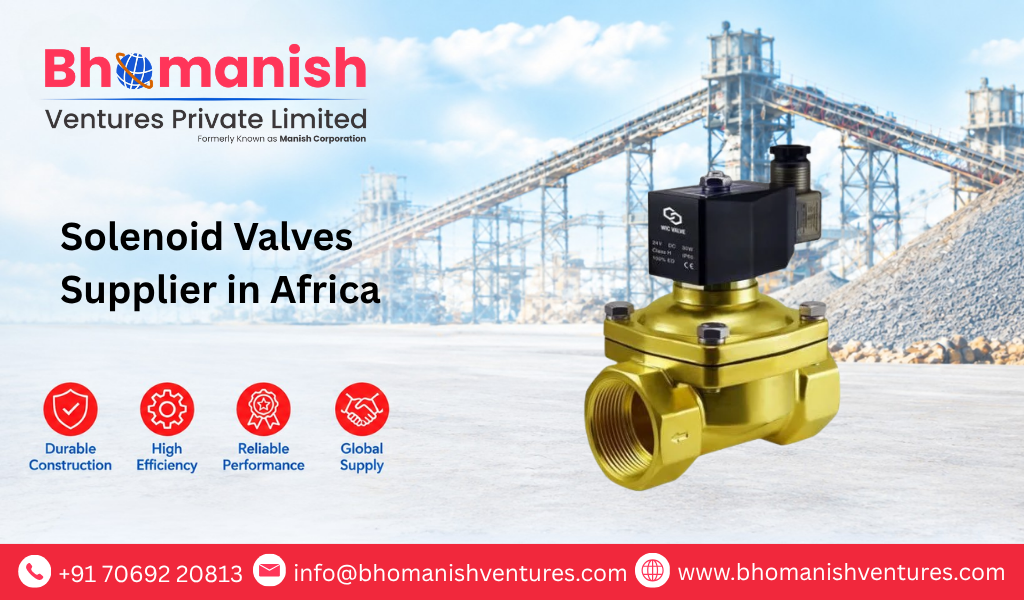
A solenoid valve is an electrically operated valve used to control fluid flow through a pipeline or process circuit. Its main operating elements generally include a solenoid coil and a valve mechanism. When an electrical signal energizes the coil, a magnetic field moves an internal plunger or related mechanism, allowing the valve to open or close according to its design.
Depending on the application, solenoid valves can be configured for different operating principles, port arrangements, connection styles, and fluid conditions. Some are intended for simple on/off control, while particular designs are selected for systems with specific pressure or flow requirements.
For buyers comparing a Top Solenoid Valves Supplier in Africa, the important question should therefore be whether the valve is appropriate for the actual process—not simply whether it is available at a competitive price.
Materials and Technical Considerations
Material selection should begin with the medium passing through the valve. Valve bodies may be manufactured from materials selected for mechanical strength, corrosion resistance, temperature conditions, and application compatibility. Internal components and seals also need to be suitable for the intended fluid and operating environment.
Important technical parameters can include:
- Valve size and port configuration
- Connection type and pipeline compatibility
- Operating pressure and temperature
- Fluid type and viscosity
- Coil voltage and electrical requirements
- Normally open or normally closed configuration
- Seal and elastomer compatibility
- Required flow capacity
- Ambient environmental conditions
- Frequency of operation
A Solenoid Valves Manufacturer or supplier should be able to help buyers match these factors with their system requirements. For installations exposed to dust, moisture, chemicals, temperature variations, or continuous cycling, environmental conditions should be considered alongside basic valve specifications.
Key Features and Benefits for Industrial Control
The primary advantage of solenoid valves is the ability to control fluid flow through an electrical signal. This makes them useful in automated systems where manual valve operation would be inconvenient or inconsistent.
Depending on the selected configuration, benefits may include:
- Quick electrical actuation
- Compatibility with automated control systems
- Compact installation possibilities
- Repeatable opening and closing
- Reduced need for manual intervention
- Integration with sensors, controllers, and process equipment
- Availability in different materials and connection arrangements
For a Best Solenoid Valves Supplier in Africa, product suitability should remain central to the purchasing process. A valve that matches the application can contribute to smoother system operation, whereas an incorrectly selected valve may create leakage, inadequate flow, premature seal wear, or control problems.
Industry-Wise Applications Across Africa
Solenoid valves can be used across numerous industries because electrically controlled fluid isolation is required in many types of equipment.
In water and wastewater systems, they can be incorporated into automated flow-control arrangements. In manufacturing plants, they may control pneumatic or fluid circuits associated with machinery. Food and beverage processing can require valves selected specifically for the process medium and hygiene requirements. In packaging machinery, solenoid valves can support automated pneumatic functions.
Other applications may include:
- HVAC and cooling systems
- Compressed-air equipment
- Irrigation systems
- Chemical processing
- Pharmaceutical equipment
- Industrial automation
- Process-control machinery
- Boiler and utility systems, where the valve design is appropriate
Because operating environments differ substantially between applications and regions, buyers searching for Solenoid Valves in Africa should provide application information before finalizing a product.
Common Buyer Problems and What to Check Before Buying
One frequent purchasing problem is selecting a valve based only on nominal pipe size. Matching the connection size does not automatically mean the valve will work correctly in a particular system.
Buyers should also verify whether the valve is suitable for the actual fluid, pressure, temperature, electrical supply, flow requirement, and operating cycle. Another common issue is overlooking the distinction between normally closed and normally open configurations.
If you are searching for a Solenoid Valves Supplier Near me, location can be useful for communication and logistics, but technical support and product suitability remain important. Bhomanish Ventures Private Limited can assist buyers in identifying the information needed to select an appropriate configuration rather than relying on assumptions.
For businesses planning to Buy Solenoid Valves in Africa, it is also useful to request product documentation, applicable material information, connection details, and operating parameters before placing an order.
How to Select a Supplier and Evaluate Solenoid Valves Price
Before requesting a Solenoid Valves Price in Africa, prepare the basic application details. These can include the fluid, line size, pressure, temperature, electrical voltage, valve function, connection requirement, and quantity.
A practical buying process is:
- Identify the controlled medium.
- Confirm operating pressure and temperature.
- Determine required valve size and connection.
- Select normally open or normally closed operation.
- Confirm coil voltage and electrical compatibility.
- Check sealing and body-material suitability.
- Compare documentation, supply capability, and commercial terms.
- Confirm that the proposed configuration matches the application.
Price should be considered alongside suitability, expected operating conditions, availability, and replacement requirements. Buyers looking to Buy Solenoid Valves for Sale in Africa should avoid comparing products purely by unit cost when their specifications are different.
Businesses evaluating a Solenoid Valves Supplier & Exporter in Africa should additionally clarify packaging, documentation, order quantities, delivery arrangements, and any destination-specific import requirements applicable to their transaction.
FAQs About Solenoid Valves
1. What is the main purpose of a solenoid valve?
It provides electrically controlled opening or closing of a fluid passage, making it useful in automated fluid and process-control systems.
2. How do I choose the correct solenoid valve?
Start with the fluid, pressure, temperature, flow requirement, connection size, electrical voltage, valve configuration, and sealing-material compatibility.
3. Are solenoid valves suitable for automation?
Yes. Their electrical actuation allows them to be integrated with controllers, sensors, timers, and other automated equipment when the valve is correctly selected.
4. What causes solenoid valve performance problems?
Incorrect fluid compatibility, unsuitable pressure or temperature, electrical mismatch, contamination, improper installation, and inappropriate valve selection can contribute to operating problems.
5. Should I choose normally open or normally closed?
The correct configuration depends on the required system behaviour when the solenoid is energized or de-energized and should be determined from the control-system requirements.
6. How can I compare suppliers?
Compare technical suitability, product documentation, communication, configuration options, commercial terms, and supply support rather than evaluating price alone.
7. Can Bhomanish Ventures Private Limited help with valve selection?
Yes. Buyers can provide their application requirements so the appropriate solenoid-valve configuration can be evaluated before ordering.
Solenoid Valves Supplier selection is ultimately an application-specific decision. By checking fluid compatibility, operating conditions, electrical requirements, connection details, and supplier support, African buyers can make a more informed purchasing decision and reduce the risk of choosing an unsuitable valve.
Tags : Solenoid Valves Supplier in Africa, Top Solenoid Valves Supplier in Africa, Best Solenoid Valves Supplier in Africa, Solenoid Valves Supplier, Solenoid Valves Manufacturer, Solenoid Valves Supplier Near me, Solenoid Valves in Africa, Solenoid Valves Supplier & Exporter in Africa, Solenoid Valves Price in Africa, Buy Solenoid Valves in Africa, Buy Solenoid Valves for Sale in Africa, Solenoid Valves Supplier in Johannesburg, Solenoid Valves Supplier in Durban, Solenoid Valves Supplier in Lagos, Solenoid Valves Supplier in Cairo, Solenoid Valves Supplier in Alexandria, Solenoid Valves Supplier in Accra, Solenoid Valves Supplier in Nairobi, Solenoid Valves Supplier in Tunis.