

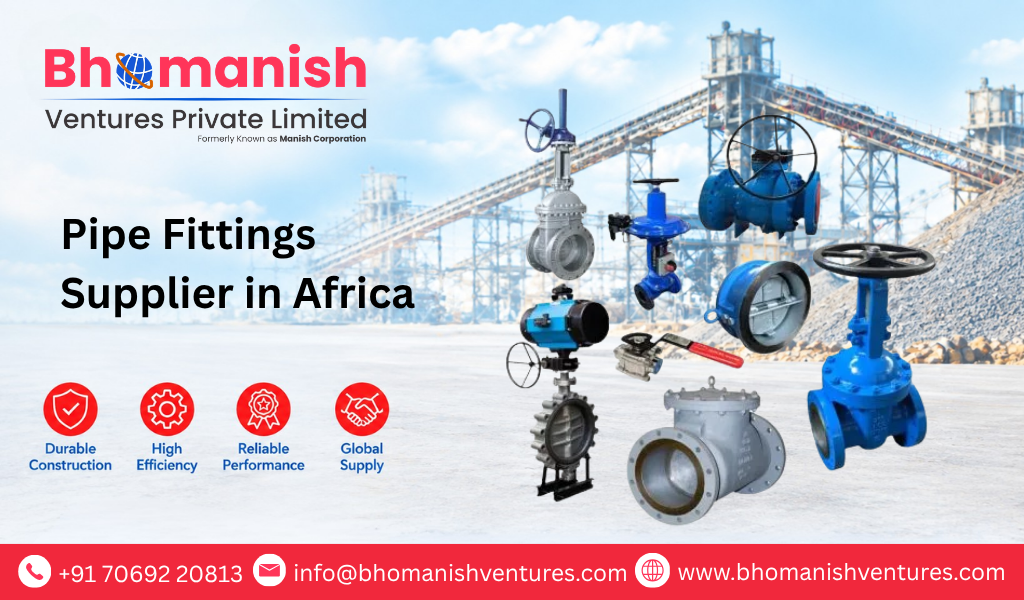
Pipe Fittings Supplier in Africa – Selection, Applications, Materials & Buying Guide
Choosing the right pipe fittings is important for maintaining reliable flow, secure connections, and efficient installation across industrial and commercial piping systems. Buyers looking for a Pipe Fittings Supplier in Africa often need more than a product catalogue—they need suitable materials, connection types, dimensional compatibility, application guidance, and dependable supply.
Bhomanish Ventures Private Limited supports buyers by helping them identify pipe fitting solutions according to piping requirements, operating conditions, and installation needs. Whether the requirement involves process piping, water systems, manufacturing facilities, infrastructure, or maintenance projects, selecting the appropriate fitting can reduce installation difficulties and help maintain system performance.
What Are Pipe Fittings and How Do They Work?
Pipe fittings are components used to connect, redirect, branch, reduce, extend, or terminate sections of piping. Common forms include elbows, tees, reducers, couplings, crosses, caps, and other connection components.
A Pipe Fittings Supplier should understand that fitting selection depends on more than pipe size. The connection method, material compatibility, pressure and temperature conditions, fluid characteristics, installation environment, and applicable dimensional requirements can all influence the appropriate product.
For example, an elbow changes the direction of a pipeline, while a tee creates a branch connection. A reducer connects pipes of different sizes, and a cap closes the end of a pipe. Choosing the correct configuration helps ensure that the fitting integrates properly with the surrounding piping system.
Materials and Technical Considerations
Material selection should begin with the application rather than simply the purchase price. Depending on the project, buyers may evaluate carbon steel, stainless steel, alloy materials, or other suitable engineering materials.
A Pipe Fittings Manufacturer or supplier should be able to discuss factors such as:
- Pipe outside diameter and wall thickness
- Required fitting dimensions and connection type
- Fluid or media being transported
- Operating temperature and pressure
- Corrosion and environmental exposure
- Welding, threading, or other joining requirements
- Applicable drawings, specifications, and standards
- Quantity and installation schedule
For corrosive environments, material compatibility becomes particularly important. Similarly, systems exposed to elevated temperatures or demanding operating conditions may require careful material and design evaluation.
Key Features and Benefits for Industrial Buyers
A Top Pipe Fittings Supplier in Africa should help buyers match fittings with actual project requirements instead of treating every application identically. Correctly selected fittings can simplify installation, support consistent pipeline routing, and reduce compatibility problems during assembly.
Important characteristics may include accurate dimensions, appropriate connection geometry, suitable material selection, and compatibility with the pipe system. Buyers should also confirm whether fittings are required for new construction, plant expansion, replacement, or maintenance work.
Bhomanish Ventures Private Limited can be considered when sourcing requirements call for a structured approach to product selection and supply. The objective should be to obtain fittings that correspond with the project's documented requirements rather than selecting products solely on appearance or initial cost.
Industry-Wise Applications
Pipe Fittings in Africa can be required across a wide range of industrial and infrastructure environments. The actual fitting configuration and material should always be selected according to the specific system.
Common applications include:
- Water and wastewater: Pipeline routing, branching, connection, and maintenance requirements.
- Oil and gas: Process and utility piping where material and operating conditions require careful consideration.
- Chemical processing: Systems where fluid compatibility and corrosion resistance can be significant factors.
- Power and utilities: Piping networks supporting plant utilities and associated services.
- Manufacturing: Production lines, compressed-air systems, process piping, and plant services.
- Construction and infrastructure: Water distribution, industrial facilities, and mechanical installations.
- Maintenance projects: Replacement of worn, damaged, or incorrectly matched fittings.
For each industry, buyers should provide drawings, pipe details, operating conditions, and required quantities whenever available.
Common Buyer Problems and Requirements
One common purchasing challenge is ordering a fitting based only on nominal pipe size. Two fittings can appear similar while having different dimensions, connection arrangements, materials, or intended applications.
Another issue is incomplete project information. A Best Pipe Fittings Supplier in Africa should ideally receive details such as pipe size, fitting type, material requirement, quantity, connection method, destination, and any project specification.
Buyers searching for a Pipe Fittings Supplier Near me may also prioritise delivery convenience, communication, availability, and after-sales coordination. For international sourcing, documentation, packing, shipping terms, and destination requirements may become additional considerations.
Before requesting a quotation, buyers should clearly define whether they need standard catalogue fittings, replacement components, or project-specific requirements.
Selection and Buying Guide
When deciding where to Buy Pipe Fittings in Africa, use a requirement-based purchasing process:
- Identify the fitting type: Determine whether the system requires elbows, tees, reducers, couplings, caps, or another configuration.
- Confirm pipe dimensions: Verify the relevant dimensions from engineering drawings or existing components.
- Select the material: Consider the fluid, environment, temperature, and corrosion conditions.
- Confirm connection requirements: Check whether the installation requires welded, threaded, flanged, or another connection arrangement.
- Review project requirements: Provide applicable drawings, specifications, standards, and inspection requirements.
- Compare quotations carefully: A Pipe Fittings Price in Africa should be assessed alongside material, dimensions, quantity, documentation, packaging, logistics, and other applicable commercial factors.
- Confirm supply details: Clarify quantity, delivery location, lead time, packing, and documentation before placing the order.
A supplier should be able to distinguish between confirmed product information and requirements that need engineering verification.
Supply, Performance and Maintenance Considerations
For buyers sourcing from outside their immediate market, a Pipe Fittings Supplier & Exporter in Africa should provide clear information regarding product availability, packing, shipping arrangements, and commercial documentation where applicable. Export requirements can vary according to destination and transaction terms, so buyers should confirm these details before ordering.
Once installed, fittings should be inspected as part of the overall piping maintenance program. Visible corrosion, leakage, damaged connections, abnormal vibration, or other system changes should be investigated according to the relevant maintenance procedures.
For projects where replacement fittings are required, keeping accurate records of fitting type, material, dimensions, and installation location can make future procurement more efficient.
FAQs
1. What should I provide when requesting pipe fittings?
Provide the fitting type, pipe dimensions, material requirement, quantity, connection type, application, destination, and any drawings or specifications available.
2. How do I choose the right pipe fitting material?
Material selection depends on the transported fluid, operating environment, temperature, pressure, corrosion exposure, and project requirements.
3. Can I buy different types of fittings from one supplier?
Yes, depending on the supplier's product range. Buyers should submit a consolidated requirement so availability and compatibility can be reviewed together.
4. How should I compare Pipe Fittings Price in Africa?
Compare quotations based on material, dimensions, specifications, quantity, documentation, packaging, delivery terms, and other applicable costs—not price alone.
5. What does a pipe fitting manufacturer do?
A manufacturer produces fittings according to defined designs, dimensions, materials, and applicable production requirements. The exact manufacturing capabilities depend on the supplier.
6. Can pipe fittings be used for maintenance and replacement projects?
Yes. Replacement fittings are commonly required during maintenance, but the existing pipe dimensions, material, connection type, and application should be verified before ordering.
7. Where can I Buy Pipe Fittings for Sale in Africa?
Buyers should evaluate suppliers based on product suitability, documented specifications, supply capability, communication, and delivery requirements. Bhomanish Ventures Private Limited can be approached with the project's technical and commercial requirements for further discussion.
Tags : Pipe Fittings Supplier in Africa, Top Pipe Fittings Supplier in Africa, Best Pipe Fittings Supplier in Africa, Pipe Fittings Supplier, Pipe Fittings Manufacturer, Pipe Fittings Supplier Near me, Pipe Fittings in Africa, Pipe Fittings Supplier & Exporter in Africa, Pipe Fittings Price in Africa, Buy Pipe Fittings in Africa, Buy Pipe Fittings for Sale in Africa, Pipe Fittings Supplier in Johannesburg, Pipe Fittings Supplier in Durban, Pipe Fittings Supplier in Lagos, Pipe Fittings Supplier in Cairo, Pipe Fittings Supplier in Alexandria, Pipe Fittings Supplier in Accra, Pipe Fittings Supplier in Nairobi, Pipe Fittings Supplier in Tunis.