





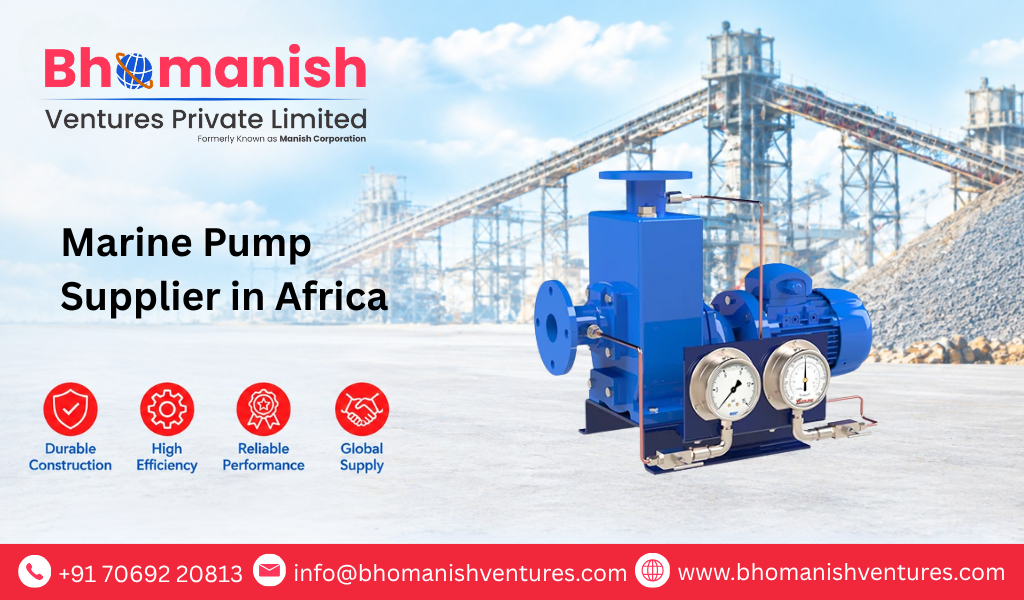
Marine Pump Supplier in Africa
Marine and offshore operations depend on reliable pumping systems for ballast water, bilge management, seawater circulation, firefighting support, cooling, drainage, and other fluid-handling duties. Selecting the right Marine Pump Supplier in Africa therefore requires more than comparing prices. Buyers need to consider the application, fluid characteristics, operating environment, installation arrangement, maintenance requirements, and availability of technical support.
For shipyards, marine contractors, offshore facilities, ports, vessel operators, and industrial users, Bhomanish Ventures Private Limited can support procurement decisions by focusing on application requirements rather than offering a one-size-fits-all pumping solution. A suitable marine pump should be selected according to the actual duty and operating conditions to achieve dependable performance over its service life.
What Is a Marine Pump and How Does It Work?
A marine pump is a mechanical fluid-handling device designed for applications associated with vessels, ports, offshore installations, and marine-related industrial systems. Depending on the application, pumps may be used to transfer, circulate, drain, or pressurize different liquids.
The basic working principle depends on the pump design. A centrifugal pump, for example, uses rotating components to impart energy to the liquid and move it through connected piping. Other pump designs may use positive displacement principles when the application requires controlled fluid movement or handling characteristics that differ from conventional centrifugal pumping.
When choosing a Marine Pump Supplier in Africa, buyers should first define the liquid being handled, required flow conditions, pressure or head requirements, operating temperature, installation arrangement, and expected operating cycle. These factors influence pump selection more than the product name alone.
Materials and Technical Considerations
Marine environments can expose equipment to moisture, salt-laden air, corrosion risks, vibration, and demanding operating conditions. Material selection should therefore be based on the liquid, environmental exposure, and system requirements.
Important considerations may include:
- Pump construction and wetted-part material
- Compatibility with seawater or other handled liquids
- Shaft, seal, and bearing arrangement
- Corrosion resistance requirements
- Motor and power-source compatibility
- Suction conditions and piping arrangement
- Required flow and pressure performance
- Installation space and connection requirements
- Accessibility for inspection and servicing
A professional Marine Pump Manufacturer should evaluate the complete application before recommending a configuration. Buyers should avoid selecting equipment solely from a catalogue image or nominal pump size because actual system requirements can vary significantly between vessels and facilities.
Key Features and Benefits Buyers Should Look For
A properly selected marine pumping system can contribute to consistent fluid movement and easier operation. However, the practical benefits depend on correct sizing, installation, and maintenance.
When evaluating a Marine Pump Supplier, buyers can look for application-focused engineering, suitable material choices, clear technical documentation, serviceability, and responsive communication. Depending on the application, useful features may include a compact arrangement, accessible components, appropriate sealing, robust construction, and compatibility with existing piping and electrical systems.
For international procurement, documentation is also important. Product drawings, operating information, installation instructions, inspection requirements, and maintenance guidance can make installation and future servicing easier.
Marine Pump Applications Across Africa
Demand for marine pumping equipment can arise from different sectors, and each application may require a different pump arrangement.
Shipping and vessel operations: Pumps may support bilge handling, ballast-related systems, cooling circulation, drainage, and other onboard fluid-management duties.
Ports and harbours: Pumping equipment can be used in drainage, utility systems, maintenance facilities, and fluid-transfer applications associated with port infrastructure.
Shipbuilding and repair: Shipyards may require pumps for vessel construction, testing, maintenance, and workshop-related fluid handling.
Offshore operations: Offshore facilities can require dependable pumping for utility, drainage, cooling, circulation, and other process-support duties.
Marine infrastructure: Coastal industrial facilities and marine service providers may use pumps for water movement and supporting utility systems.
This means a Marine Pump in Africa should not be selected simply because it is marketed for marine use. The specific operating duty remains the starting point for choosing an appropriate configuration.
Common Buyer Problems and How to Select the Right Pump
One common purchasing problem is insufficient application information. Buyers may know the required pump type but lack complete details about flow, pressure, liquid properties, operating hours, or installation conditions. This can make accurate selection difficult.
Another concern is purchasing equipment based only on Marine Pump Price in Africa. Initial price is important, but buyers should also consider maintenance accessibility, replacement-part availability, operating requirements, installation compatibility, and expected service conditions.
Before choosing a Marine Pump Supplier in Africa, prepare the following information wherever available:
- Type and purpose of the application
- Liquid to be pumped
- Required flow and pressure/head
- Liquid temperature and relevant properties
- Suction and discharge arrangement
- Power supply and motor requirements
- Installation location and available space
- Operating hours or duty cycle
- Material and corrosion-resistance requirements
- Required documentation and delivery expectations
If you are searching for a Marine Pump Supplier Near me, online proximity alone should not determine the purchase. Technical suitability, communication, documentation, after-sales support, and supply capability can be equally important.
Maintenance, Supply and Buyer FAQs
Routine inspection helps identify issues before they affect system operation. Depending on the pump design and application, maintenance may involve checking seals, bearings, connections, alignment, vibration, unusual noise, leakage, and operating performance. Maintenance intervals should always follow the manufacturer's instructions and the actual service conditions.
For international purchasing, buyers looking for a Marine Pump Supplier & Exporter in Africa should confirm product documentation, packing requirements, delivery arrangements, and applicable import or compliance requirements before placing an order. Bhomanish Ventures Private Limited can discuss application requirements and supply considerations with buyers seeking suitable marine pumping solutions.
FAQs
1. How do I choose a marine pump for my application?
Start with the liquid, required flow, pressure/head, temperature, installation arrangement, operating cycle, and material requirements. These details allow the pump configuration to be matched to the actual duty.
2. Is the cheapest marine pump always the most economical option?
Not necessarily. Buyers should consider purchase cost together with installation, maintenance, replacement components, operating requirements, and expected service conditions.
3. Can marine pumps handle seawater?
Some pump configurations are suitable for seawater applications, but material compatibility and pump construction must be checked against the actual service conditions.
4. What should I ask before I buy marine pumping equipment?
Ask about application suitability, construction materials, performance information, installation requirements, documentation, maintenance needs, and available technical support.
5. Can I Buy Marine Pump in Africa for a new vessel or replacement project?
Yes, provided the selected pump matches the vessel or system requirements. For replacement projects, existing pump data and piping information can help simplify selection.
6. Where can I Buy Marine Pump for Sale in Africa?
Buyers should compare suppliers based on technical suitability, documentation, supply capability, service support, and application experience rather than price alone.
7. How should I compare a Top Marine Pump Supplier in Africa with another supplier?
Compare the suppliers on application understanding, product suitability, documentation, communication, maintenance support, and ability to meet the project's actual requirements.
Tags : Marine Pump Supplier in Africa, Top Marine Pump Supplier in Africa, Best Marine Pump Supplier in Africa, Marine Pump Supplier, Marine Pump Manufacturer, Marine Pump Supplier Near me, Marine Pump in Africa, Marine Pump Supplier & Exporter in Africa, Marine Pump Price in Africa, Buy Marine Pump in Africa, Buy Marine Pump for Sale in Africa, Marine Pump Supplier in Johannesburg, Marine Pump Supplier in Durban, Marine Pump Supplier in Lagos, Marine Pump Supplier in Cairo, Marine Pump Supplier in Alexandria, Marine Pump Supplier in Accra, Marine Pump Supplier in Nairobi, Marine Pump Supplier in Tunis.