





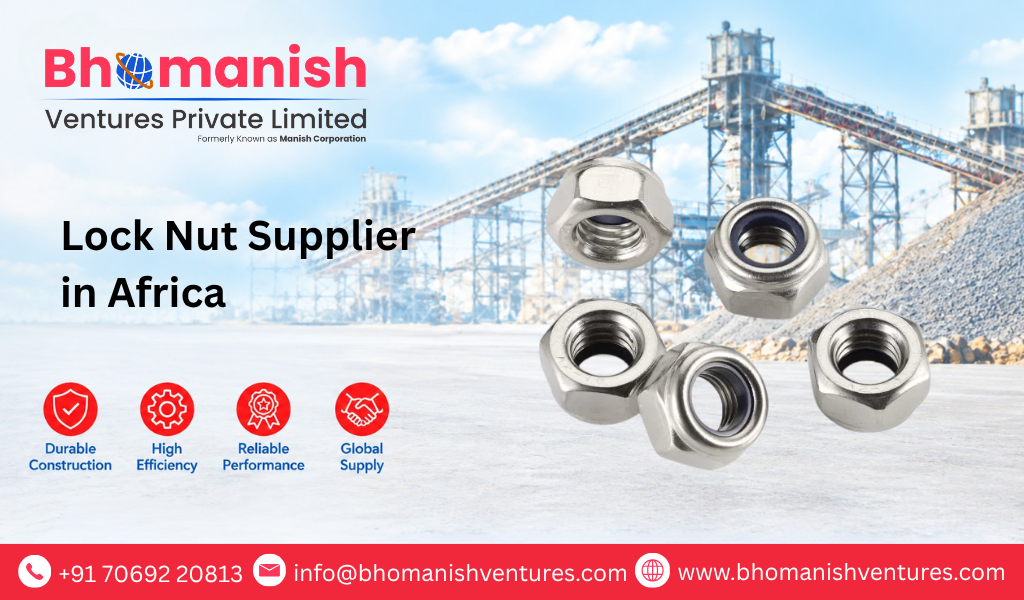
Lock Nut Supplier in Africa: A Practical Buyer’s Guide for Industrial Applications
When machinery operates under vibration, repeated movement, or fluctuating loads, ordinary nuts may not provide the level of fastening security required for dependable operation. Buyers therefore look for locking solutions that suit their equipment, assembly method, material requirements, and service environment. Choosing the right Lock Nut Supplier in Africa is not simply about comparing prices; it involves understanding thread compatibility, locking mechanism, material, dimensions, application conditions, and supply requirements.
For businesses sourcing industrial fastening components, Lock Nut Supplier selection can directly affect assembly reliability and maintenance practices. Bhomanish Ventures Private Limited can support buyers seeking suitable locking nut solutions by helping them evaluate product requirements before purchase.
What Is a Lock Nut and How Does It Work?
A lock nut is a threaded fastening component designed to resist unwanted loosening after installation. Depending on its design, the locking action can be achieved through features such as controlled thread interference, deformation, friction, or a secondary locking arrangement.
Unlike a standard nut, a lock nut is selected when the joint may experience conditions that encourage rotation. The correct design depends on the application rather than simply the nut's appearance.
For example, a fastening joint on industrial equipment exposed to recurring vibration may require a different locking approach from a stationary structural assembly. Buyers searching for a Top Lock Nut Supplier in Africa should therefore provide details about thread size, mating bolt or stud, operating environment, installation method, and expected service conditions.
Material and Technical Considerations
Material selection should begin with the environment in which the fastening component will operate. Common industrial choices can include carbon steel, alloy steel, and stainless steel, depending on the application and required corrosion resistance.
Thread compatibility is equally important. A lock nut must match the thread form, nominal size, and pitch of the corresponding fastener. Using an incorrectly matched thread can cause installation problems or compromise the joint.
Buyers should also consider:
- Nut dimensions and available installation space
- Thread size and pitch
- Base material and required mechanical characteristics
- Surface finish or coating requirements
- Temperature and environmental exposure
- Repeated assembly and disassembly requirements
- Compatibility with the mating bolt, stud, or shaft
A Best Lock Nut Supplier in Africa should be able to discuss these parameters rather than offering a product based only on a nominal size.
Key Features and Practical Benefits
The principal purpose of a locking nut is to help maintain fastening security under the conditions for which its design is intended. This can be particularly relevant in equipment containing moving components or assemblies exposed to vibration.
Depending on the selected design, useful characteristics may include secure thread engagement, repeatable installation, compatibility with standard fastening systems, and suitability for particular industrial environments.
For procurement teams comparing a Lock Nut Manufacturer, it is useful to ask whether the supplier can provide dimensional information and material details relevant to the intended application. This makes technical comparison easier and reduces the risk of selecting a component that looks suitable but does not match the assembly.
Industry-Wise Applications
Lock nuts can be used across different industrial environments where threaded joints require additional resistance to loosening. Applications may include machinery assemblies, fabrication equipment, automotive-related components, electrical equipment, agricultural machinery, pumps, industrial maintenance systems, and general engineering projects.
The actual selection varies by application. For instance, a maintenance team replacing fastening components on rotating equipment may prioritize locking performance and installation consistency, while a fabrication company may focus more heavily on dimensions, material availability, and production quantities.
Businesses looking for Lock Nut in Africa may therefore benefit from specifying the equipment type and joint application when requesting quotations.
Common Buyer Problems and Requirements
One common purchasing mistake is ordering based only on the phrase “lock nut” without defining the exact requirement. Different locking designs are not automatically interchangeable.
Another issue is uncertainty about the correct size. Buyers should confirm the mating fastener's thread details before placing an order. If the application has unusual environmental conditions, those should also be communicated.
When contacting a Lock Nut Supplier & Exporter in Africa, buyers should ideally provide:
- Required nut type or locking mechanism
- Thread size and pitch
- Required material
- Quantity
- Surface finish, if applicable
- Intended application
- Packaging or identification requirements
For buyers comparing Lock Nut Price in Africa, quotations should be evaluated against material, dimensions, quantity, finish, packaging, and other agreed requirements rather than comparing the unit price alone.
How to Select and Buy the Right Lock Nut
Before deciding where to Buy Lock Nut in Africa, prepare the technical details of the existing fastening assembly. Check the bolt or stud specification, thread compatibility, available installation clearance, and environmental conditions.
If local availability is limited, an industrial supplier with broader supply capabilities may be considered. Buyers searching for a Lock Nut Supplier Near me can also compare suppliers based on technical communication, documentation, order quantities, consistency, and delivery arrangements.
For procurement teams looking to Buy Lock Nut for Sale, bulk requirements should be discussed early so that the supplier understands expected quantities and packaging needs. Bhomanish Ventures Private Limited can assist buyers in identifying requirements and discussing suitable fastening solutions according to the information provided.
Maintenance and Performance Considerations
Even an appropriate lock nut cannot compensate for incorrect installation or an unsuitable mating fastener. Assemblies should be installed according to the relevant engineering requirements and checked for thread damage, contamination, corrosion, or other visible issues.
During maintenance, technicians should inspect fastening components when equipment is serviced, particularly where joints experience repeated movement or vibration. Replacement decisions should consider the nut's condition and the requirements of the assembly rather than automatically reusing a component.
A structured procurement process helps maintain consistency across replacement parts and reduces uncertainty during maintenance.
Frequently Asked Questions
1. What does a lock nut do?
A lock nut is designed to help resist unwanted loosening of a threaded joint. The specific locking effect depends on the nut's design and the conditions of use.
2. How do I choose the correct lock nut size?
Confirm the mating bolt or stud's thread size and pitch, then select a compatible lock nut. Dimensional requirements should also be checked against the available installation space.
3. Does material matter when buying lock nuts?
Yes. Material selection can depend on mechanical requirements, corrosion exposure, temperature, and the surrounding equipment. The supplier should be given application details before selection.
4. How should I compare lock nut suppliers?
Compare technical suitability, material information, dimensional consistency, order requirements, documentation, communication, and agreed delivery terms—not only the quoted price.
5. What information should I provide when requesting a quotation?
Provide the nut type, thread details, material preference, quantity, application, finish requirements, and any relevant drawings or specifications.
6. Can lock nuts be used in machinery?
They can be used in many machinery and engineering assemblies, but the appropriate locking design must be selected according to the joint's operating conditions.
7. How can I check whether a quoted product is suitable?
Compare the supplier's dimensional and material information with your assembly requirements. Where necessary, provide a drawing, sample, or existing fastener details for technical review.
Tags : Lock Nut Supplier in Africa, Top Lock Nut Supplier in Africa, Best Lock Nut Supplier in Africa, Lock Nut Supplier, Lock Nut Manufacturer, Lock Nut Supplier Near me, Lock Nut in Africa, Lock Nut Supplier & Exporter in Africa, Lock Nut Price in Africa, Buy Lock Nut in Africa, Buy Lock Nut for Sale in Africa, Lock Nut Supplier in Johannesburg, Lock Nut Supplier in Durban, Lock Nut Supplier in Lagos, Lock Nut Supplier in Cairo, Lock Nut Supplier in Alexandria, Lock Nut Supplier in Accra, Lock Nut Supplier in Nairobi, Lock Nut Supplier in Tunis.