
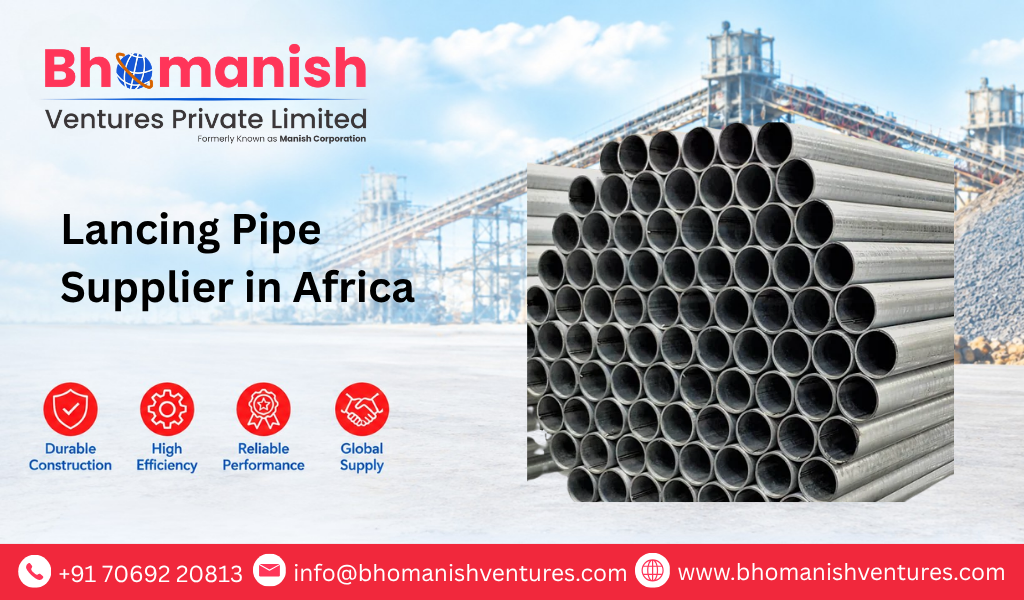
Lancing Pipe Supplier in Africa: Selection, Applications, Materials, and Buying Guide
Industrial buyers in steelmaking, foundries, metal processing, and high-temperature operations often require lancing pipes that can deliver reliable performance under demanding working conditions. Choosing the right supplier involves more than comparing prices. Buyers need to consider pipe construction, dimensions, material compatibility, operating environment, handling requirements, and supply consistency. This guide explains the practical factors to evaluate when sourcing lancing pipes for African industrial applications, while highlighting how Bhomanish Ventures Private Limited can support informed procurement decisions.
What Is a Lancing Pipe and How Does It Work?
A lancing pipe is an industrial tubular component used to introduce gases, oxygen, powders, or other process materials into furnaces, molten-metal systems, and related high-temperature applications, depending on the process design. Its exact construction and service life depend on the application, temperature exposure, process medium, and handling conditions.
A Lancing Pipe Supplier in Africa should therefore understand the intended process before recommending a product. Pipe length, outside diameter, wall construction, material, connection arrangement, and surface condition can all influence suitability.
In practical use, the pipe acts as a controlled passage between the supply arrangement and the process zone. During operation, the lance must remain sufficiently stable for the intended task while accommodating the thermal and mechanical conditions of the application.
Material and Technical Considerations
Material selection is one of the most important considerations when purchasing lancing equipment. Different applications can expose pipes to heat, oxidation, mechanical impact, abrasion, or contact with process materials.
A Lancing Pipe Manufacturer should evaluate factors such as:
- Required pipe dimensions and overall length
- Process temperature and exposure duration
- Gas or material being introduced
- Required stiffness and handling characteristics
- Connection or fitting requirements
- Surface condition and dimensional consistency
- Storage and transportation conditions
For example, a lance used repeatedly around a furnace may have different requirements from one intended for a specific short-duration operation. Buyers should provide process information rather than selecting solely from a generic dimensional catalogue.
For organizations comparing a Lancing Pipe Supplier, documentation regarding available materials, dimensions, manufacturing practices, inspection procedures, and packing arrangements can help establish whether the product matches the intended service.
Key Features and Benefits for Industrial Buyers
The value of a suitable lancing pipe is closely connected with process requirements rather than a single universal specification. Buyers generally look for dimensional consistency, appropriate construction, dependable handling, and compatibility with their operating environment.
Working with a Top Lancing Pipe Supplier in Africa can help procurement teams focus on application-specific requirements instead of purchasing based only on the lowest quoted price.
Potential advantages of properly selected lancing pipes include:
- Consistent physical dimensions for installation and handling
- Suitability for defined industrial processes
- Easier integration with existing process arrangements
- Better purchasing decisions through application-based selection
- Reduced risk of ordering incompatible dimensions or materials
- More predictable repeat procurement when specifications are clearly documented
For Lancing Pipe in Africa, transportation and packaging also deserve attention. Industrial pipes can be damaged through unsuitable handling, so buyers should clarify packaging, bundling, identification, and dispatch requirements before confirming an order.
Industry-Wise Applications
Lancing pipes can be relevant to several industrial environments where controlled introduction of process media is required.
Steel and metal processing: Furnaces and metal-treatment operations may use lancing arrangements as part of controlled process operations. The required design depends on the furnace configuration and operating procedure.
Foundries: Foundry processes may require lancing equipment for specific furnace or molten-metal applications. Pipe dimensions and construction should be selected according to the process conditions.
Ferrous and non-ferrous industries: Different metal-processing environments can impose different thermal and chemical demands, making application-specific material selection important.
Recycling and secondary metal processing: Operations handling recovered metal may have variable process requirements. Buyers should explain their operating conditions when requesting a quotation.
A Lancing Pipe Supplier & Exporter in Africa can be particularly useful for businesses that need organized supply across industrial locations, provided shipping, documentation, and product requirements are established clearly in advance.
Common Buyer Problems and How to Avoid Them
One common purchasing mistake is ordering a pipe based only on nominal size. Two products with similar dimensions may not necessarily be appropriate for the same process.
Another issue is unclear communication about application conditions. Buyers should specify the process, approximate operating environment, required quantity, dimensions, material preference, and connection details wherever applicable.
When reviewing Lancing Pipe Price in Africa, procurement teams should also consider the complete supply requirement rather than comparing only the unit price. Packaging, quantity, customization, shipping arrangements, and order specifications can affect the final procurement cost.
Before deciding to Buy Lancing Pipe in Africa, ask the supplier for clear product details and confirm that the offered construction corresponds to your intended use. Bhomanish Ventures Private Limited can discuss requirements with buyers and help structure specifications before an order is finalized.
Selection, Buying, and Supply Guide
The selection process becomes easier when buyers follow a defined checklist. Start by identifying the process and application. Next, determine the required dimensions, material, length, quantity, and connection arrangement. If the product will be exposed to demanding conditions, provide the relevant operating information to the supplier.
For companies searching for a Best Lancing Pipe Supplier in Africa, useful questions include:
- Can the supplier provide the required dimensions and material?
- Can the product be supplied consistently for repeat orders?
- Are packaging and identification suitable for international transportation?
- Can the supplier clarify the intended application and limitations?
- Are commercial terms and delivery requirements clearly documented?
Businesses looking for Lancing Pipe Supplier Near me may find local sourcing convenient, but international procurement can also be practical when product requirements, quantities, logistics, and documentation are clearly coordinated.
Buyers seeking Lancing Pipe for Sale should avoid treating a standard listing as automatically suitable for every application. Technical suitability should be confirmed before purchase.
Frequently Asked Questions
1. What is a lancing pipe used for?
It is used in selected industrial processes to introduce gases, oxygen, powders, or other process materials into furnaces or related process environments, depending on the application.
2. How do I choose the right lancing pipe?
Consider the application, operating conditions, required dimensions, material, length, connection requirements, and expected handling conditions.
3. Does lancing pipe material matter?
Yes. Material selection should correspond to the mechanical, thermal, and process conditions in which the pipe will be used.
4. How should I compare lancing pipe prices?
Compare the complete supply specification, including dimensions, material, quantity, packaging, customization requirements, and applicable transportation costs rather than comparing unit price alone.
5. Can lancing pipes be supplied for African markets?
Supply feasibility depends on the required product, quantity, destination, commercial terms, and shipping arrangements. These details should be confirmed with the supplier before ordering.
6. What information should I provide when requesting a quotation?
Provide the application, required dimensions, length, material preference, quantity, destination, and any connection or packaging requirements available.
7. Why should industrial buyers confirm application details before ordering?
Because lancing pipes are used across different processes, and a dimensionally similar product may not be appropriate for every operating environment. Clear application information supports more accurate product selection.
Tags : Lancing Pipe Supplier in Africa, Top Lancing Pipe Supplier in Africa, Best Lancing Pipe Supplier in Africa, Lancing Pipe Supplier, Lancing Pipe Manufacturer, Lancing Pipe Supplier Near me, Lancing Pipe in Africa, Lancing Pipe Supplier & Exporter in Africa, Lancing Pipe Price in Africa, Buy Lancing Pipe in Africa, Buy Lancing Pipe for Sale in Africa, Lancing Pipe Supplier in Johannesburg, Lancing Pipe Supplier in Durban, Lancing Pipe Supplier in Lagos, Lancing Pipe Supplier in Cairo, Lancing Pipe Supplier in Alexandria, Lancing Pipe Supplier in Accra, Lancing Pipe Supplier in Nairobi, Lancing Pipe Supplier in Tunis.