

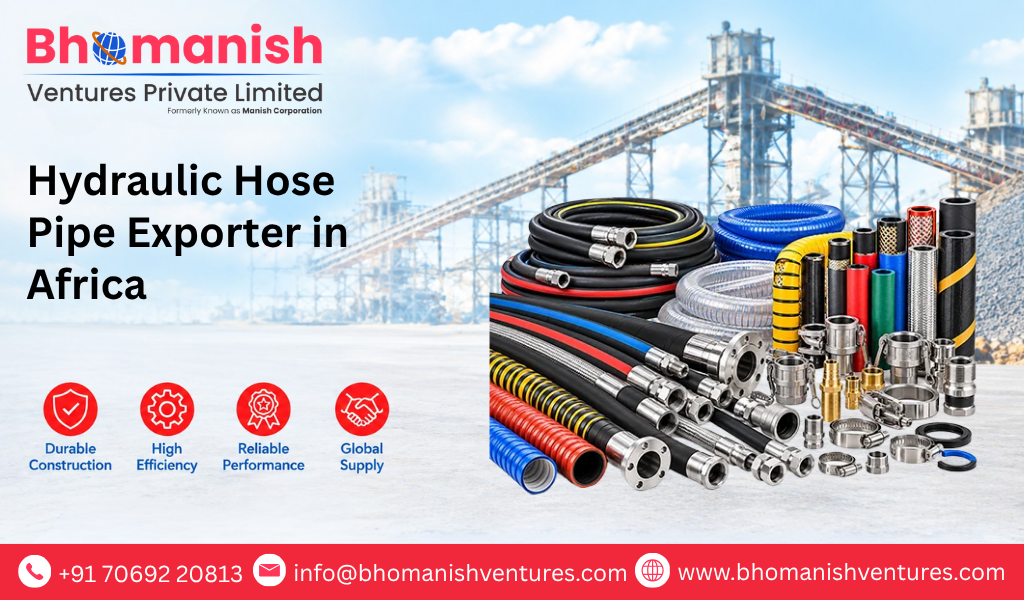
Hydraulic Hose Pipe Exporter in Africa
Industrial machinery across Africa often operates in demanding environments where hydraulic systems must transfer pressurized fluid reliably. Construction equipment, mining machinery, agricultural systems, material-handling equipment, and industrial plants all depend on properly selected hydraulic hoses for efficient power transmission. For buyers, the challenge is not simply finding a hose at a competitive price; it is identifying the right combination of pressure capability, hose construction, connection type, flexibility, and application suitability.
As an international industrial supply company, Bhomanish Ventures Private Limited supports buyers seeking dependable hydraulic hose solutions for different equipment and operating requirements. When evaluating a Hydraulic Hose Pipe Exporter in Africa, purchasers should consider application conditions first and supplier capability second. This approach helps avoid premature hose failure, leakage, unnecessary downtime, and incorrect replacements.
What Is a Hydraulic Hose Pipe and How Does It Work?
A hydraulic hose is a flexible pressure-carrying component used to transport hydraulic fluid between system components such as pumps, valves, cylinders, motors, and actuators. Unlike rigid piping, a hose can accommodate movement and vibration, making it useful in mobile and dynamic machinery.
A typical hydraulic hose consists of an inner tube, reinforcement layer, and outer cover. The inner tube is selected to handle the hydraulic fluid, while reinforcement provides resistance against internal pressure. The outer cover protects the assembly from surrounding environmental conditions.
For buyers comparing a Hydraulic Hose Pipe Manufacturer, the important point is that hose construction should match the working environment rather than being selected only by nominal size. Correct internal diameter, pressure requirements, routing, bend conditions, fluid compatibility, and end connections all influence performance.
Material and Technical Considerations
Hydraulic hose selection requires attention to several technical factors. The inner tube material should be compatible with the hydraulic fluid being used. Reinforcement may be designed around the pressure and flexibility requirements of the application, while the external cover needs to suit the surrounding environment.
Buyers should provide information such as:
- Hydraulic fluid or media being conveyed
- Required hose inside and outside dimensions
- Operating and peak pressure requirements
- Working temperature range
- Required hose length
- Minimum bend requirements
- Fitting and connection configuration
- Exposure to abrasion, moisture, dust, heat, or outdoor conditions
- Whether the hose will remain stationary or experience continuous movement
These details are particularly important when comparing a Hydraulic Hose Pipe Supplier in Africa because apparently similar hoses may have different construction and application suitability.
Key Benefits and Common Industrial Applications
A properly selected hose assembly can help hydraulic equipment transfer fluid efficiently while accommodating movement between connected components. Flexible hoses are especially useful where vibration, articulation, or equipment movement makes rigid connections impractical.
In Africa, potential applications can include:
- Mining: hydraulic equipment, mobile machinery, and material-handling systems
- Construction: excavators, loaders, cranes, and other hydraulic machinery
- Agriculture: tractors, harvesting equipment, and hydraulic implements
- Manufacturing: hydraulic presses, production machinery, and automated equipment
- Material handling: lifting and positioning systems
- Industrial maintenance: replacement hose assemblies for existing hydraulic systems
The correct hose can also simplify maintenance because worn assemblies can be replaced without redesigning an entire hydraulic circuit.
Common Buyer Problems and Requirements
One of the most common purchasing problems is ordering a hose based only on its visible dimensions. A hose can appear physically suitable while having unsuitable pressure, temperature, fluid compatibility, or fitting characteristics.
Buyers looking at Hydraulic Hose Pipe in Africa may also need to address different operating environments. Mining applications, for example, can expose hoses to abrasion and difficult working conditions, while agricultural equipment may experience outdoor exposure, repeated movement, and seasonal operation.
Another frequent concern is Hydraulic Hose Pipe Price in Africa. Price should be assessed together with construction, connection requirements, service conditions, expected replacement needs, and supply consistency. The lowest initial price does not necessarily represent the lowest overall maintenance cost.
For urgent replacement requirements, buyers may search for Hydraulic Hose Pipe Exporter Near me, but distance alone should not determine supplier selection. Product suitability, documentation, communication, and delivery coordination are also important.
How to Select and Buy the Right Hydraulic Hose
Before deciding where to Buy Hydraulic Hose Pipe in Africa, prepare the existing hose information whenever possible. Product markings, equipment manuals, photographs, measurements, and fitting details can help a supplier understand the requirement.
A practical buying checklist includes:
- Confirm the required hose size and length.
- Identify the hydraulic fluid or application medium.
- Establish normal and maximum operating pressure.
- Check operating temperature conditions.
- Identify both end connections accurately.
- Consider movement, vibration, and bend requirements.
- Assess environmental exposure such as abrasion, heat, moisture, and dust.
- Confirm packaging, quantity, documentation, and delivery requirements.
- Request product information before approving the order.
Buyers looking for Buy Hydraulic Hose Pipe for Sale in Africa should also distinguish between complete hose assemblies and hose-only requirements, because the fitting configuration can materially affect the final product selection.
Supply, Performance and Maintenance Considerations
When sourcing from an international Hydraulic Hose Pipe Exporter, buyers should communicate their technical requirement clearly before placing an order. Bhomanish Ventures Private Limited can work with application information to help buyers identify an appropriate hydraulic hose solution rather than relying on a generic product description.
Regular inspection is important after installation. Check for visible abrasion, cuts, swelling, leakage, damaged covers, unusual bending, or movement that could place excessive stress on the assembly. Hoses should also be routed away from unnecessary rubbing and sharp contact points.
For companies comparing the Top Hydraulic Hose Pipe Exporter in Africa or the Best Hydraulic Hose Pipe Exporter in Africa, the practical evaluation should focus on product suitability, technical communication, consistency of supply, and the supplier's ability to understand the intended application.
Frequently Asked Questions
1. What information should I provide when ordering a hydraulic hose?
Provide hose size, length, hydraulic fluid, operating pressure and temperature, fitting details, equipment type, and application conditions whenever available.
2. Can hydraulic hoses be used in mining equipment?
Yes, hydraulic hoses are commonly used in hydraulic systems on mobile and industrial equipment. The hose construction should be selected according to the equipment's pressure, movement, fluid, and environmental requirements.
3. How can I compare Hydraulic Hose Pipe Price in Africa?
Compare quotations using equivalent hose dimensions, construction, fittings, quantities, packaging, and delivery terms. Comparing price alone can produce misleading results.
4. Is a hydraulic hose suitable for every hydraulic fluid?
No. Compatibility depends on the hose's internal tube material and the particular fluid and operating conditions. The application should be confirmed before selection.
5. What causes hydraulic hose failure?
Potential causes include incorrect hose selection, excessive bending, abrasion, unsuitable operating conditions, damaged fittings, improper routing, or general service deterioration.
6. Should I buy a complete hose assembly or hose only?
It depends on your requirement. If replacement involves a complete connected assembly, providing fitting details and hose dimensions can help the supplier determine the appropriate configuration.
7. Can Bhomanish Ventures Private Limited supply hydraulic hose requirements for African buyers?
Bhomanish Ventures Private Limited can discuss hydraulic hose requirements based on application, dimensions, connection details, and quantity, allowing buyers to clarify the appropriate supply requirement before ordering.
Tags : Hydraulic Hose Pipe Exporter in Africa, Top Hydraulic Hose Pipe Exporter in Africa, Best Hydraulic Hose Pipe Exporter in Africa, Hydraulic Hose Pipe Exporter, Hydraulic Hose Pipe Manufacturer, Hydraulic Hose Pipe Exporter Near me, Hydraulic Hose Pipe in Africa, Hydraulic Hose Pipe Supplier in Africa, Hydraulic Hose Pipe Price in Africa, Buy Hydraulic Hose Pipe in Africa, Buy Hydraulic Hose Pipe for Sale in Africa, Hydraulic Hose Pipe Exporter in Johannesburg, Hydraulic Hose Pipe Exporter in Durban, Hydraulic Hose Pipe Exporter in Lagos, Hydraulic Hose Pipe Exporter in Cairo, Hydraulic Hose Pipe Exporter in Alexandria, Hydraulic Hose Pipe Exporter in Accra, Hydraulic Hose Pipe Exporter in Nairobi, Hydraulic Hose Pipe Exporter in Tunis.