

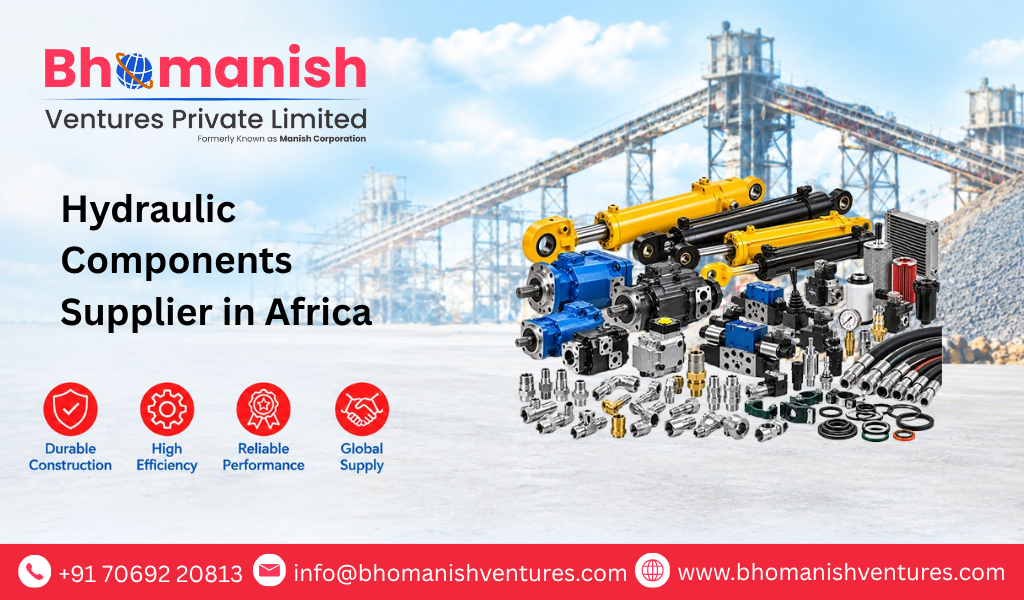
Hydraulic Components Supplier in Africa: A Practical Guide for Industrial Buyers
Choosing the right hydraulic components is essential for maintaining reliable fluid-power systems in construction, mining, agriculture, manufacturing, material handling, and other demanding industries. Buyers looking for a Hydraulic Components Supplier in Africa often need more than a product catalogue—they need compatible components, dependable quality, correct specifications, responsive support, and predictable supply.
As a sourcing partner, Bhomanish Ventures Private Limited can help businesses evaluate hydraulic components according to application requirements rather than selecting products only by price. Whether the requirement involves replacement parts, new equipment assembly, or maintenance inventory, understanding the component type, operating conditions, connection details, and system compatibility can reduce avoidable purchasing problems.
What Are Hydraulic Components and How Do They Work?
Hydraulic components are mechanical elements used in fluid-power systems to control, direct, pressurize, or transmit hydraulic fluid. Depending on the system, they may include hydraulic valves, pumps, cylinders, motors, filters, fittings, hoses, manifolds, and related accessories.
A hydraulic system generally uses pressurized fluid to transfer energy between components. The pump moves hydraulic fluid, valves control its direction or flow, and actuators such as cylinders or motors convert hydraulic energy into mechanical movement.
For buyers comparing a Hydraulic Components Manufacturer or Hydraulic Components Supplier, compatibility is particularly important. A component that appears suitable based on dimensions alone may not be appropriate if its pressure range, fluid compatibility, connection type, flow requirements, or operating environment differs from the application.
Material and Technical Considerations
The correct component depends heavily on the working conditions of the hydraulic system. Buyers should consider several technical factors before placing an order.
Material selection: Components may use different metals, elastomers, seals, and protective finishes depending on the application. The material should be appropriate for the hydraulic fluid, temperature, mechanical loading, and environmental exposure.
Pressure and flow: System pressure and required flow influence the selection of pumps, valves, hoses, fittings, and other components. Buyers should refer to the equipment manufacturer's specifications rather than selecting solely from a generic product description.
Connection and dimensions: Thread type, port configuration, mounting dimensions, bore size, shaft dimensions, and installation arrangement can determine whether a replacement component will fit correctly.
Fluid compatibility: Hydraulic fluids are not universally interchangeable with every seal or component material. The fluid being used should therefore be confirmed before ordering.
These details are particularly important when sourcing Hydraulic Components in Africa for equipment operating in mining, construction, agricultural, or industrial environments where downtime can have significant operational consequences.
Key Features and Benefits for Industrial Users
Quality hydraulic components can contribute to consistent equipment operation when correctly matched to the system. Depending on the component and application, buyers may look for:
- Accurate dimensional compatibility
- Suitable pressure and flow characteristics
- Appropriate sealing arrangements
- Durable construction for the intended environment
- Consistent manufacturing quality
- Correct port and connection configuration
- Availability of replacement or complementary components
- Documentation that supports installation and identification
For companies comparing the Best Hydraulic Components Supplier in Africa or a Top Hydraulic Components Supplier in Africa, it is useful to assess product compatibility, technical communication, documentation, supply capability, and after-sales coordination rather than relying only on promotional claims.
Industry-Wise Applications
Hydraulic components are used across many industries because hydraulic power can operate equipment requiring controlled force and movement.
Construction: Excavators, loaders, cranes, lifting systems, and other mobile machinery use hydraulic circuits for controlled movement and load handling.
Mining: Hydraulic systems are found in mining machinery and material-handling equipment. Components may need to withstand demanding operating environments and regular maintenance requirements.
Agriculture: Tractors, harvesters, irrigation equipment, and agricultural machinery can use hydraulic cylinders, valves, pumps, and fittings for lifting and positioning functions.
Manufacturing: Industrial machinery may incorporate hydraulic power for pressing, clamping, forming, lifting, and controlled movement.
Material handling: Hydraulic components can support equipment such as lifting platforms, handling machinery, and industrial positioning systems.
For these applications, a Hydraulic Components Supplier & Exporter in Africa should understand the difference between a routine replacement requirement and a component intended for a specialized hydraulic circuit.
Common Buyer Problems and Requirements
One common purchasing problem is ordering a component without confirming the complete system requirements. Buyers may have an old component but lack its original part number, technical drawing, or manufacturer documentation.
In such cases, useful information can include photographs, existing markings, dimensions, connection details, application information, hydraulic-fluid type, and available equipment documentation.
Another concern is sourcing components solely according to Hydraulic Components Price in Africa. A lower initial price does not necessarily mean the component is appropriate for the application. Incorrect compatibility can lead to installation delays, repeated replacement, or equipment downtime.
Businesses searching for Hydraulic Components Supplier Near me may also prioritize local availability, while larger industrial buyers may require coordinated supply across multiple locations. The purchasing approach should therefore reflect the equipment's operational requirements and replenishment schedule.
How to Select and Buy Hydraulic Components
Before you Buy Hydraulic Components in Africa, prepare a clear requirement sheet. Include the equipment model, component type, existing part number if available, dimensions, connection information, operating conditions, and quantity.
Then compare suppliers based on:
- Product compatibility with the intended hydraulic system.
- Availability of relevant technical information.
- Ability to identify replacement or equivalent components.
- Quality-control and identification practices.
- Packaging suitable for transportation and storage.
- Communication regarding lead time and order quantities.
- Availability of related components when required.
If the requirement is for Buy Hydraulic Components for Sale in Africa, distributors and resellers should also consider product identification, repeat availability, packaging, and demand patterns before building inventory.
Bhomanish Ventures Private Limited can be approached with application and component details so that the sourcing process can focus on the actual requirement rather than an unsuitable generic substitute.
Maintenance, Performance and Supply Considerations
Correct installation is only one part of hydraulic-system reliability. Regular inspection can help identify leakage, damaged hoses, worn seals, contamination, loose connections, or other visible problems before they become larger maintenance issues.
Hydraulic components should also be stored appropriately and protected from contamination, moisture, impact, and unnecessary exposure to harsh conditions. Replacement parts should remain clearly identified so technicians can distinguish different specifications and applications.
For international procurement, buyers should confirm packaging, documentation, quantities, delivery arrangements, and applicable export requirements before finalizing an order. Availability and shipping conditions can vary by destination and order size, so these details should be verified for each transaction.
Frequently Asked Questions
1. What should I provide when requesting hydraulic components?
Provide the component name, part number if available, dimensions, photographs, equipment model, application, and relevant pressure or flow information.
2. Can hydraulic components be selected without the original part number?
Sometimes. A supplier may be able to identify a suitable component using dimensions, photographs, markings, application details, and connection information, but compatibility should be verified before purchase.
3. How can I compare Hydraulic Components Price in Africa?
Compare prices alongside specifications, compatibility, quantity, packaging, delivery terms, and documentation rather than evaluating price alone.
4. What industries commonly use hydraulic components?
Construction, mining, agriculture, manufacturing, material handling, and various mobile and industrial equipment sectors commonly use hydraulic systems.
5. Is every hydraulic valve interchangeable?
No. Valve function, port configuration, flow requirements, pressure characteristics, mounting arrangement, and system design can differ significantly.
6. What should I check before replacing a hydraulic component?
Check the original component identification, dimensions, connections, operating requirements, fluid compatibility, and equipment manufacturer's specifications.
7. Can Bhomanish Ventures Private Limited supply hydraulic components for industrial requirements?
Requirements can be discussed based on the component type, application, specifications, quantity, and destination so that the appropriate sourcing and supply options can be evaluated.
Tags : Hydraulic Components Supplier in Africa, Top Hydraulic Components Supplier in Africa, Best Hydraulic Components Supplier in Africa, Hydraulic Components Supplier, Hydraulic Components Manufacturer, Hydraulic Components Supplier Near me, Hydraulic Components in Africa, Hydraulic Components Supplier & Exporter in Africa, Hydraulic Components Price in Africa, Buy Hydraulic Components in Africa, Buy Hydraulic Components for Sale in Africa, Hydraulic Components Supplier in Johannesburg, Hydraulic Components Supplier in Durban, Hydraulic Components Supplier in Lagos, Hydraulic Components Supplier in Cairo, Hydraulic Components Supplier in Alexandria, Hydraulic Components Supplier in Accra, Hydraulic Components Supplier in Nairobi, Hydraulic Components Supplier in Tunis.