

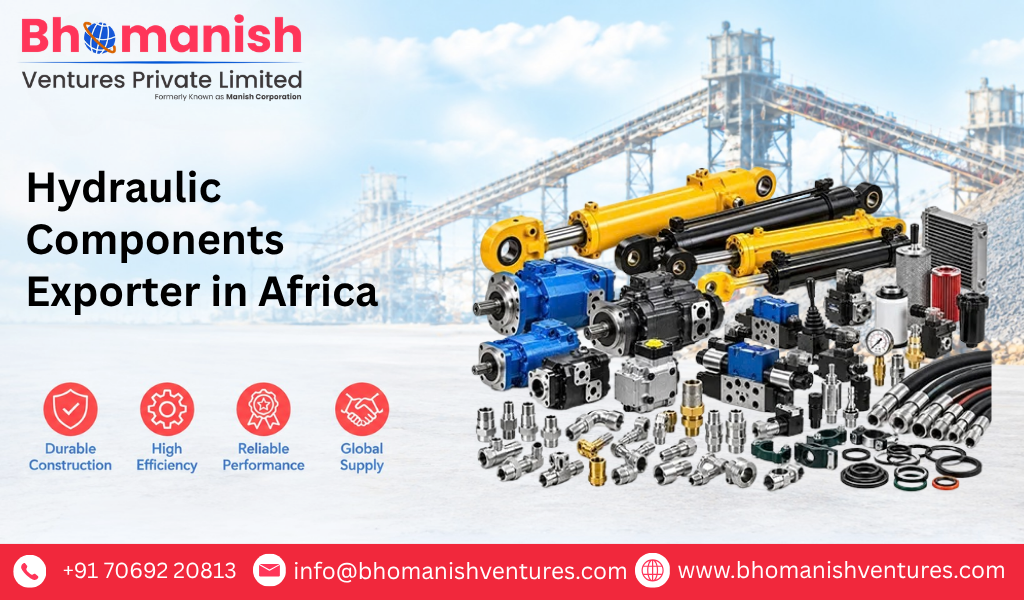
Hydraulic Components Exporter in Africa
African industries increasingly depend on hydraulic systems for controlled movement, lifting, pressing, steering, clamping, and material handling. When equipment operates in demanding environments, buyers need components that are compatible with their hydraulic systems, correctly specified, and supported by dependable supply. This makes choosing a suitable Hydraulic Components Exporter in Africa an important purchasing decision for machinery manufacturers, maintenance teams, distributors, construction companies, mining operations, and industrial users.
Bhomanish Ventures Private Limited can serve buyers looking for hydraulic components with attention to application requirements, component compatibility, and supply coordination. Rather than selecting parts only by price, buyers should consider pressure requirements, connection standards, operating conditions, fluid compatibility, dimensions, and replacement availability.
What Are Hydraulic Components and How Do They Work?
Hydraulic components are parts used within hydraulic circuits to generate, control, direct, or transmit hydraulic power. Depending on the application, a system may include pumps, valves, cylinders, hydraulic motors, filters, fittings, hoses, manifolds, accumulators, and related accessories.
A hydraulic pump converts mechanical input into fluid flow. Control valves regulate the direction, pressure, or flow of hydraulic fluid, while cylinders and motors convert fluid power into mechanical movement. Hoses, tubes, fittings, and manifolds provide the connections needed to circulate fluid through the system.
For buyers comparing a Hydraulic Components Manufacturer or Hydraulic Components Exporter, understanding the function of each component helps prevent incorrect replacement and compatibility problems.
Material and Technical Considerations
The material and construction of a hydraulic component should match its operating environment. Components may be exposed to pressure fluctuations, vibration, temperature changes, dust, moisture, corrosive surroundings, or continuous operating cycles.
Before purchasing Hydraulic Components in Africa, buyers should provide relevant technical information such as:
- Component type and application
- Required dimensions and connection details
- Operating pressure and flow requirements
- Hydraulic fluid being used
- Operating temperature
- Machine model or existing component reference
- Installation environment
- Required quantity and replacement schedule
For example, a valve used in a mobile construction machine may have different selection requirements from one installed in a stationary industrial press. Correct identification is therefore more useful than selecting a component based solely on appearance.
Key Features and Benefits for Industrial Buyers
A reliable hydraulic component should provide appropriate functional performance within the limits specified for its application. Buyers commonly look for accurate fitment, suitable materials, consistent manufacturing quality, and dependable availability.
Working with a Top Hydraulic Components Exporter in Africa can also simplify sourcing when multiple component types are required for the same project. Instead of managing unrelated purchases, industrial buyers can coordinate their requirements around equipment models, replacement schedules, and application needs.
Important benefits of properly selected hydraulic components include:
- Reliable fluid control
- Effective power transmission
- Reduced compatibility issues
- Easier replacement and maintenance
- Better integration with existing hydraulic circuits
- More organized spare-parts procurement
However, actual service life and performance depend on system design, operating conditions, installation, maintenance, and component selection.
Applications Across African Industries
Hydraulic systems are used across many sectors, so component requirements can vary substantially. Construction equipment may require components for lifting, steering, digging, or attachment movement. Mining machinery can use hydraulic systems for heavy-duty mechanical operations, while agricultural equipment may rely on hydraulics for implements and positioning systems.
Other applications include material-handling equipment, manufacturing machinery, waste-processing systems, transportation equipment, energy-related machinery, and industrial production lines.
For this reason, a Best Hydraulic Components Exporter in Africa should not be selected simply through generic product descriptions. Buyers should communicate the actual machine application so the required component can be identified correctly.
Common Buyer Problems and How to Select the Right Supplier
One common sourcing problem is ordering a visually similar component without confirming dimensions, ports, pressure requirements, or compatibility. Another is purchasing from a supplier without providing sufficient information about the existing hydraulic circuit.
When evaluating a Hydraulic Components Supplier in Africa, buyers should ask:
- Does the supplier understand the intended application?
- Can the required component specifications be clearly documented?
- Are connection dimensions and component references confirmed?
- Can the supplier support repeat or replacement requirements?
- Is packaging appropriate for transportation and storage?
- Are commercial terms, quantities, and delivery requirements clearly communicated?
A search for Hydraulic Components Exporter Near me may help identify local sourcing options, but distance should not be the only consideration. For international procurement, documentation, communication, product identification, packaging, and logistics can be equally important.
Buyers comparing Hydraulic Components Price in Africa should also compare equivalent specifications. A lower quoted price may not represent the same component configuration, material, connection standard, or application suitability.
Buying, Supply and Maintenance Considerations
Before deciding to Buy Hydraulic Components in Africa, prepare a component list containing part references, dimensions, quantities, and application details. Where replacement parts are involved, photographs and existing component markings can also help with identification, although technical confirmation should take priority.
For buyers looking for Buy Hydraulic Components for Sale in Africa, the purchasing process should include confirmation of the exact component, quantity, packaging, commercial terms, and delivery requirements before an order is finalized.
Maintenance is equally important. Hydraulic systems should be inspected according to the equipment manufacturer's recommendations. Buyers should monitor leaks, damaged hoses, unusual operating behavior, contaminated fluid, loose connections, and other signs that may indicate a maintenance requirement. Correct installation and appropriate hydraulic-fluid management can help protect system components.
Bhomanish Ventures Private Limited can support sourcing discussions by working from the buyer's application and component requirements rather than relying on generic product descriptions. Export arrangements should be confirmed according to the specific order, destination, documentation, and logistics requirements.
FAQs
1. What should I provide when purchasing hydraulic components?
Provide the component name or part number, dimensions, connection details, machine information, application, operating requirements, quantity, and photographs where useful.
2. How do I compare hydraulic components from different suppliers?
Compare components with equivalent specifications, materials, connections, operating requirements, and intended applications rather than comparing price alone.
3. Can hydraulic components be used as direct replacements?
Only when the replacement component is compatible with the hydraulic circuit and equipment requirements. Dimensions alone do not always establish compatibility.
4. What affects Hydraulic Components Price in Africa?
Pricing can depend on component type, specification, material, quantity, sourcing conditions, packaging, transportation, and destination-related logistics.
5. Is local sourcing always better than importing?
Not necessarily. The appropriate sourcing route depends on availability, technical requirements, quantity, lead time, commercial terms, and logistics.
6. Can I order different hydraulic components together?
Yes, buyers can discuss consolidated requirements when multiple components are needed for a machine, project, maintenance program, or spare-parts inventory.
7. What makes a hydraulic component suitable for an application?
Suitability depends on factors such as function, dimensions, connections, pressure and flow requirements, fluid compatibility, operating environment, and equipment specifications.
Tags : Hydraulic Components Exporter in Africa, Top Hydraulic Components Exporter in Africa, Best Hydraulic Components Exporter in Africa, Hydraulic Components Exporter, Hydraulic Components Manufacturer, Hydraulic Components Exporter Near me, Hydraulic Components in Africa, Hydraulic Components Supplier in Africa, Hydraulic Components Price in Africa, Buy Hydraulic Components in Africa, Buy Hydraulic Components for Sale in Africa, Hydraulic Components Exporter in Johannesburg, Hydraulic Components Exporter in Durban, Hydraulic Components Exporter in Lagos, Hydraulic Components Exporter in Cairo, Hydraulic Components Exporter in Alexandria, Hydraulic Components Exporter in Accra, Hydraulic Components Exporter in Nairobi, Hydraulic Components Exporter in Tunis.