
Flanges Supplier in Africa
Choosing the right Flanges Supplier in Africa involves more than comparing prices. Industrial buyers need flange products that match the required piping dimensions, connection method, material, pressure requirements, operating environment, and installation conditions. Whether the requirement is for process piping, water infrastructure, fabrication, chemical handling, or general industrial maintenance, selecting a suitable supplier can directly affect installation compatibility and long-term service performance.
Bhomanish Ventures Private Limited serves buyers looking for dependable industrial components and can support enquiries involving different flange requirements. Instead of selecting products only on the basis of a catalogue image or quoted price, buyers should provide application details so the required flange type, material, dimensions, and standards can be evaluated correctly.
What Are Flanges and How Do They Work?
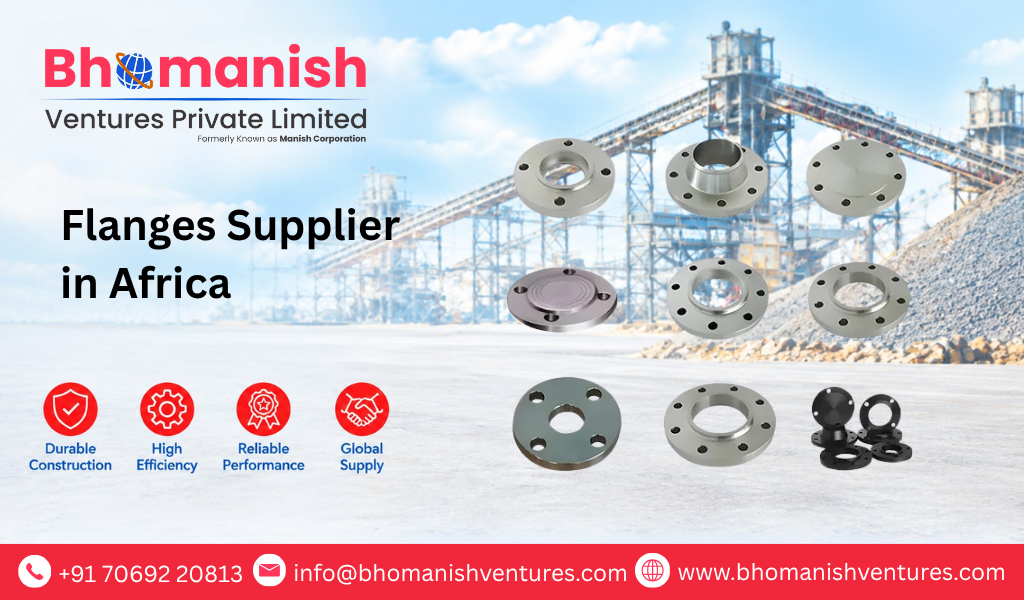
Flanges are mechanical components used to create a detachable connection between pipes, valves, pumps, fittings, and other piping equipment. Unlike permanent welded connections, a flanged joint can generally be opened when equipment inspection, replacement, or maintenance is required.
A typical flanged connection uses two mating flange faces with a gasket positioned between them. Bolting provides the clamping force required to maintain the joint. The actual design depends on the flange type, pipe dimensions, facing arrangement, material, and applicable standard.
For buyers researching Flanges in Africa, understanding the intended connection is important. Common requirements may include weld neck, slip-on, blind, threaded, socket weld, or other configurations depending on the piping system and application.
Materials and Technical Considerations
Material selection should be based on the operating environment rather than simply choosing the most commonly available option. Carbon steel, stainless steel, alloy steel, and other materials may be considered according to factors such as corrosion exposure, temperature, fluid characteristics, mechanical requirements, and compatibility with connected piping.
Buyers discussing requirements with a Flanges Manufacturer should provide as much technical information as possible. Useful details include:
- Nominal pipe size and outside diameter
- Required flange type
- Material or material grade
- Pressure class or applicable rating
- Flange facing requirement
- Bolt-hole arrangement
- Applicable dimensional or manufacturing standard
- Operating temperature and service medium
- Quantity and delivery destination
This information helps reduce the possibility of receiving a flange that appears suitable but does not properly match the existing piping arrangement.
Key Features and Industrial Benefits
A properly selected flange provides a practical connection point for piping and equipment while allowing future access to the system. For maintenance-intensive industries, this detachable connection can be particularly useful when components need to be inspected or removed.
The benefits of sourcing through an experienced Flanges Supplier include better attention to dimensional requirements, material selection, documentation needs, and application-specific enquiries. Flanges can also be integrated into larger piping assemblies where valves, pumps, tanks, pressure equipment, and other components require compatible connections.
For procurement teams searching for a Top Flanges Supplier in Africa, the more useful question is whether the supplier can clearly understand the project's technical and commercial requirements rather than relying only on general product availability.
Industry-Wise Applications
Flanges are used across numerous industrial and infrastructure environments. Their specific configuration varies according to the equipment and service conditions.
Oil & Gas: Flanged connections are commonly incorporated into piping and equipment assemblies where access for maintenance is important.
Chemical Processing: Material compatibility becomes particularly important where piping carries corrosive or chemically active fluids.
Water & Wastewater: Flanges can be used around pumps, valves, pipelines, treatment equipment, and related infrastructure.
Power Generation: Piping systems may require carefully matched flange dimensions and materials for different service conditions.
Engineering & Fabrication: Fabricators may use flanges when constructing skids, process assemblies, tanks, and industrial piping systems.
Mining & Heavy Industry: Piping installations can involve demanding operating environments where appropriate materials and connection arrangements are essential.
Common Buyer Problems and How to Choose
One common purchasing problem is ordering by nominal size alone. Two flanges with similar-looking dimensions may still differ in facing, bolt pattern, material, thickness, or applicable rating.
Another issue occurs when buyers search for a Flanges Supplier Near me and select a supplier solely because of geographical proximity. For industrial procurement, technical compatibility, documentation, production capability, communication, and delivery planning can be equally important.
When comparing Flanges Price in Africa, buyers should request quotations based on identical specifications. A useful comparison should consider flange type, material, size, rating, standard, quantity, packaging, delivery terms, and any required inspection or documentation.
Before placing an order to Buy Flanges in Africa, confirm the drawing or dimensional information and ensure that the supplier understands the actual application. If the requirement is for replacement parts, sharing the existing flange dimensions or equipment details can help avoid mismatches.
Supply, Export and Maintenance Considerations
For international requirements, buyers looking for a Flanges Supplier & Exporter in Africa should clarify destination, quantity, packaging expectations, required documents, and delivery terms before finalizing the purchase. Export-related arrangements can vary by order and destination, so these details should be confirmed directly for each enquiry.
Maintenance also matters after installation. Flanged joints should be inspected according to the requirements of the particular piping system. During installation, correct gasket selection, flange alignment, bolt condition, and appropriate tightening practices are important considerations. Any signs of leakage, corrosion, mechanical damage, or joint deterioration should be investigated according to the applicable maintenance procedure.
Bhomanish Ventures Private Limited can assist buyers in discussing requirements before purchasing. Whether the objective is to Buy Flanges for Sale in Africa for a new project, replacement requirement, fabrication work, or industrial inventory, providing accurate specifications helps create a more useful quotation.
Frequently Asked Questions
1. How do I choose a suitable flange?
Start with pipe size, flange type, material, pressure requirement, facing, applicable standard, and service conditions. These details should be matched with the connected piping and equipment.
2. What information should I provide when requesting a flange quotation?
Provide size, quantity, material, flange type, rating, standard, facing, application, and delivery destination wherever available.
3. Are all flanges of the same pipe size interchangeable?
No. Flanges can differ in dimensions, bolt-hole patterns, facing, thickness, material, and rating. Compatibility should therefore be confirmed before ordering.
4. What affects flange pricing?
Material, size, type, quantity, manufacturing requirements, applicable standards, documentation, packaging, and delivery arrangements can all influence the final quotation.
5. Can flanges be used for maintenance-friendly piping connections?
Yes. A flanged connection is designed as a detachable joint, making it useful where connected equipment or piping may need to be opened for inspection or maintenance.
6. Should I buy standard or customized flanges?
That depends on the project. Standard products may suit established piping requirements, while customized solutions may be considered when the application has specific dimensional or engineering requirements.
7. How can I find the right Best Flanges Supplier in Africa?
Compare suppliers based on their ability to understand your specifications, provide appropriate product information, communicate clearly, and meet your required quality, documentation, quantity, and delivery conditions rather than relying only on price.
Tags : Flanges Supplier in Africa, Top Flanges Supplier in Africa, Best Flanges Supplier in Africa, Flanges Supplier, Flanges Manufacturer, Flanges Supplier Near me, Flanges in Africa, Flanges Supplier & Exporter in Africa, Flanges Price in Africa, Buy Flanges in Africa, Buy Flanges for Sale in Africa, Flanges Supplier in Johannesburg, Flanges Supplier in Durban, Flanges Supplier in Lagos, Flanges Supplier in Cairo, Flanges Supplier in Alexandria, Flanges Supplier in Accra, Flanges Supplier in Nairobi, Flanges Supplier in Tunis.