

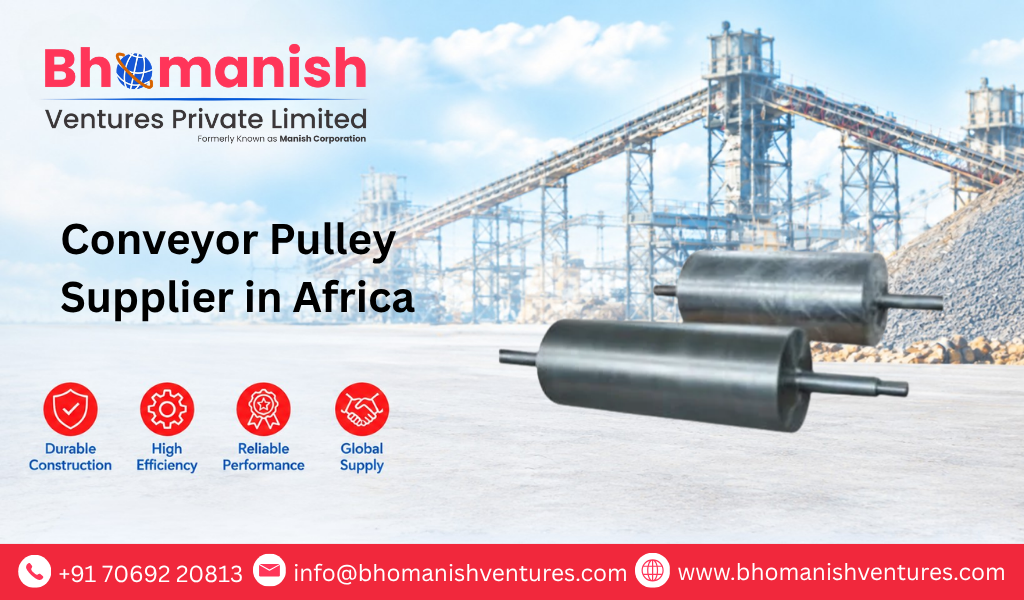
Conveyor Pulley Supplier in Africa – Selection, Applications, Buying & Performance Guide
Choosing the right pulley is important for maintaining reliable conveyor operation, especially in bulk-material handling environments where conveyors may operate continuously under demanding conditions. Buyers searching for a Conveyor Pulley Supplier in Africa typically need more than a standard component—they need a pulley suited to the conveyor arrangement, belt characteristics, material being handled, operating environment, and maintenance requirements. Bhomanish Ventures Private Limited provides conveyor pulley solutions for industrial requirements, with attention to application suitability and practical buyer needs.
This guide explains what conveyor pulleys do, how they work, important material and technical considerations, applications, common purchasing concerns, and the factors buyers should evaluate before placing an order.
What Is a Conveyor Pulley and How Does It Work?
A conveyor pulley is a rotating cylindrical component positioned within a belt conveyor system. Its primary function depends on its location and design. Drive pulleys transmit rotational force to the conveyor belt, while other pulley arrangements can support belt movement, change belt direction, or maintain appropriate belt geometry.
A Conveyor Pulley Manufacturer generally considers factors such as pulley position, belt width, shaft arrangement, operating load, conveyor configuration, and surrounding environment when developing a pulley.
For buyers looking for a Conveyor Pulley Supplier, the important point is that pulley selection should be based on the complete conveyor application rather than simply choosing a component by appearance or nominal size.
Material and Technical Considerations
Pulley construction needs to suit the operating conditions of the conveyor. The shell, shaft, end components, bearing arrangement, and surface configuration all influence how the assembly performs.
Depending on the application, buyers may need to discuss:
- Conveyor belt width and construction
- Pulley diameter and face dimensions
- Shaft arrangement and mounting requirements
- Expected operating loads
- Conveyor speed and duty cycle
- Material being transported
- Ambient conditions such as dust, moisture, or corrosive exposure
- Required lagging or pulley surface treatment
- Bearing and sealing requirements
- Available installation space
A Conveyor Pulley in Africa may be installed in applications ranging from general material handling to mining, aggregates, manufacturing, ports, and other bulk-handling operations. Therefore, environmental and operating conditions should be communicated clearly before purchasing.
Instead of selecting a pulley solely according to Conveyor Pulley Price in Africa, buyers should compare the component's suitability, construction, expected service requirements, and compatibility with their existing conveyor.
Key Features and Practical Benefits
A properly selected pulley helps the conveyor belt follow its intended path and interact effectively with the conveyor's drive and tensioning arrangement. Depending on the design, practical benefits can include consistent belt movement, appropriate belt tracking, easier integration with the conveyor structure, and manageable maintenance.
A Top Conveyor Pulley Supplier in Africa should be able to discuss the application rather than simply provide a catalogue item. Useful purchasing discussions may cover pulley dimensions, shaft requirements, belt characteristics, mounting arrangement, and environmental exposure.
Buyers comparing a Best Conveyor Pulley Supplier in Africa should also examine whether the supplier can understand drawings, specifications, existing-machine requirements, and project-specific dimensional needs.
For organizations searching Conveyor Pulley Supplier Near me, local availability may be convenient, but technical compatibility remains an important consideration when comparing suppliers.
Industry-Wise Applications
Conveyor pulleys are used across industries wherever belt conveyors move bulk or packaged materials. Different industries create different operating requirements.
Mining and mineral handling: Conveyor systems transport extracted materials over significant distances, requiring pulley selection appropriate to the conveyor arrangement and operating environment.
Cement and construction materials: Conveyors may handle clinker, aggregates, sand, stone, and other materials. Dust exposure and continuous material movement can influence component-selection discussions.
Ports and bulk terminals: Conveyor systems can be used for transferring bulk commodities between storage and transportation facilities. Pulley compatibility with the conveyor's duty and environment is important.
Food and processing industries: Material-handling arrangements can have different cleanliness and environmental requirements, depending on the specific application.
Manufacturing and warehouses: Conveyors can move components, finished products, bags, cartons, or raw materials between process stages.
This is why a Conveyor Pulley Supplier & Exporter in Africa needs to understand the intended installation rather than treating every pulley requirement as identical.
Common Buyer Problems and Requirements
One common purchasing problem is incomplete technical information. Buyers may know the belt width but not have the shaft dimensions, pulley position, or other details needed for proper selection.
Another issue is replacing an existing pulley without confirming the complete dimensional arrangement. Even when a replacement looks similar, differences in shaft dimensions, mounting, face width, or other interfaces can create installation problems.
Before requesting a quotation, buyers should ideally provide:
- Existing pulley drawing or dimensions
- Conveyor belt information
- Pulley location and function
- Shaft dimensions where available
- Operating environment
- Required quantity
- Installation or replacement requirements
- Delivery destination
If the buyer wants to Buy Conveyor Pulley in Africa, providing these details early can make supplier discussions more precise.
Selection, Buying and Performance Guide
When comparing suppliers, start by identifying the pulley function—such as drive, tail, bend, take-up, or another conveyor position. Then establish the required dimensions and interface details.
Next, discuss the operating environment and material-handling conditions. A pulley used in a dusty aggregate facility may have different considerations from one used in a controlled manufacturing environment.
Buyers should also ask about documentation, dimensional confirmation, packaging, inspection expectations, and replacement compatibility before finalizing an order.
Those looking to Buy Conveyor Pulley for Sale in Africa should avoid selecting entirely on price. A technically unsuitable component can create installation delays and additional maintenance requirements.
After installation, performance should be monitored through routine conveyor inspections. Unusual belt tracking, abnormal vibration, visible wear, bearing-area problems, or changes in operating noise can indicate that inspection is required. Maintenance schedules should follow the conveyor manufacturer's recommendations and the actual operating environment.
Bhomanish Ventures Private Limited can discuss conveyor pulley requirements based on the buyer's application, dimensions, and project needs rather than assuming one configuration fits every conveyor.
Frequently Asked Questions
1. What information should I provide when ordering a conveyor pulley?
Provide available pulley dimensions, belt information, shaft details, pulley position, operating conditions, quantity, and delivery requirements. A drawing or existing-pulley measurements can be particularly useful.
2. How do I choose a conveyor pulley for an existing conveyor?
Start with the existing pulley dimensions and mounting arrangement, then confirm the belt, shaft, operating conditions, and pulley function. Replacement compatibility should be checked before ordering.
3. Does conveyor pulley price depend only on size?
No. Pricing can depend on the configuration, materials, dimensions, shaft requirements, surface treatment, quantity, and project-specific requirements.
4. Can conveyor pulleys be used in mining applications?
Yes, conveyor pulleys are commonly used within bulk-material conveyor systems serving mining and mineral-handling operations. The appropriate configuration depends on the particular conveyor and operating conditions.
5. What should I ask a conveyor pulley supplier before buying?
Ask about dimensional compatibility, construction, shaft arrangement, application suitability, documentation, quantity requirements, packaging, and delivery arrangements.
6. Can I buy a conveyor pulley based only on belt width?
Belt width is useful information, but it is normally not enough to establish complete pulley compatibility. Other dimensions and application details should also be confirmed.
7. How can I avoid premature pulley-related problems?
Use application-appropriate components, verify installation dimensions, maintain the conveyor according to recommended procedures, and investigate unusual tracking, vibration, noise, or visible wear promptly.
Tags : Conveyor Pulley Supplier in Africa, Top Conveyor Pulley Supplier in Africa, Best Conveyor Pulley Supplier in Africa, Conveyor Pulley Supplier, Conveyor Pulley Manufacturer, Conveyor Pulley Supplier Near me, Conveyor Pulley in Africa, Conveyor Pulley Supplier & Exporter in Africa, Conveyor Pulley Price in Africa, Buy Conveyor Pulley in Africa, Buy Conveyor Pulley for Sale in Africa, Conveyor Pulley Supplier in Johannesburg, Conveyor Pulley Supplier in Durban, Conveyor Pulley Supplier in Lagos, Conveyor Pulley Supplier in Cairo, Conveyor Pulley Supplier in Alexandria, Conveyor Pulley Supplier in Accra, Conveyor Pulley Supplier in Nairobi, Conveyor Pulley Supplier in Tunis.