

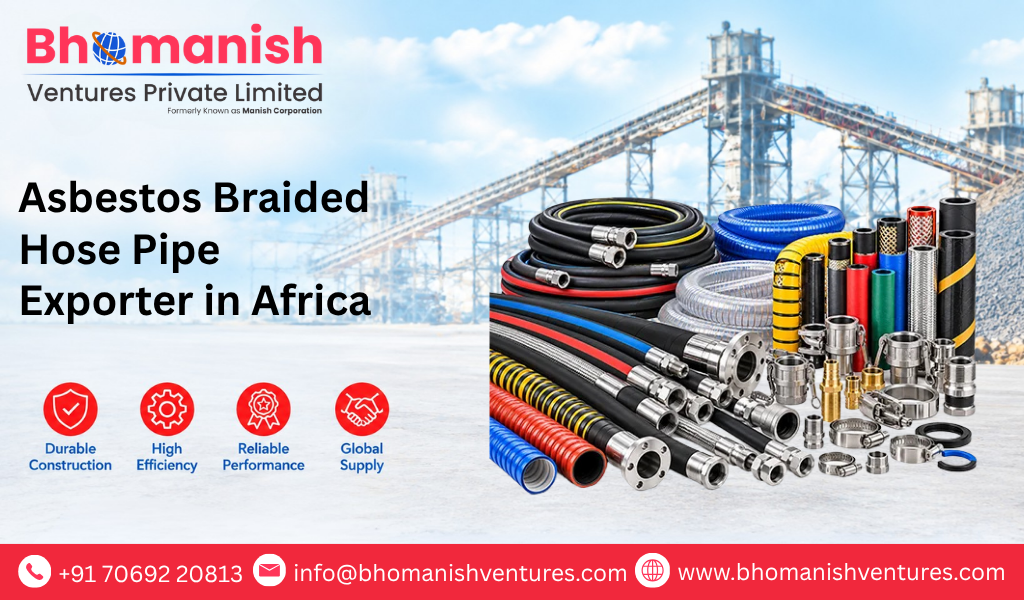
Asbestos Braided Hose Pipe Exporter in Africa
Industrial hose requirements can become challenging when an application involves elevated temperatures, mechanical stress, legacy equipment, or environments where conventional hose constructions may not be suitable. Buyers searching for an Asbestos Braided Hose Pipe Exporter in Africa generally need more than a product name—they need clarity about construction, intended service conditions, regulatory requirements, documentation, and whether asbestos-containing materials are legally permitted for the application.
Bhomanish Ventures Private Limited approaches such requirements with an emphasis on application assessment and responsible supply. Because asbestos is a recognized hazardous material and its use is restricted or prohibited in many jurisdictions and applications, buyers should verify applicable African national regulations before placing an order. Where asbestos-free alternatives can safely meet the requirement, they should also be evaluated.
What Is an Asbestos Braided Hose Pipe and How Does It Work?
An asbestos braided hose pipe traditionally refers to a flexible hose construction incorporating asbestos-based material with braided reinforcement. Historically, asbestos was used in certain industrial products because of its resistance to heat and its ability to provide insulation.
The braided structure is intended to provide mechanical reinforcement around the hose body, while the internal construction is selected according to the medium and operating environment. However, the presence of asbestos creates significant occupational-health, handling, disposal, and regulatory considerations.
For this reason, an Asbestos Braided Hose Pipe Manufacturer or exporter should not treat material selection as a simple catalogue decision. The buyer needs to establish whether asbestos-containing products are permitted at the destination, whether import restrictions apply, and whether an alternative construction can satisfy the same engineering requirement.
Material and Technical Considerations for African Buyers
When evaluating an Asbestos Braided Hose Pipe in Africa, buyers should first identify the actual service conditions rather than selecting a hose solely by nominal size or price.
Important considerations include:
- Working temperature and expected temperature variations
- Fluid or gas being conveyed
- Internal and external pressure requirements
- Hose diameter and connection arrangement
- Required flexibility and minimum bend conditions
- Mechanical abrasion or environmental exposure
- Frequency of movement or vibration
- Installation environment
- Applicable safety and import regulations
- Availability of asbestos-free alternatives
The exact construction, reinforcement, dimensions, and performance characteristics should be confirmed against the manufacturer's documentation for the specific product. Avoid relying on generic internet specifications when the hose is intended for critical industrial service.
For many modern applications, buyers should specifically ask whether an asbestos-free hose can provide the required thermal, mechanical, or insulation performance. This can reduce the regulatory and occupational concerns associated with asbestos-containing materials.
Key Benefits, Limitations and Buyer Requirements
Historically, asbestos-based hose constructions were selected for demanding thermal environments. That historical performance should not, however, be interpreted as evidence that an asbestos product is appropriate or legal for a current application.
A responsible Top Asbestos Braided Hose Pipe Exporter in Africa should help buyers understand both the product's intended application and its limitations. Documentation should clearly identify the material composition rather than leaving buyers to assume that a hose is asbestos-free.
Common buyer requirements include consistent dimensions, appropriate end connections, traceable product information, packaging suitable for transportation, and documentation required for customs or industrial procurement.
Buyers should also consider the complete lifecycle of the product. Storage, installation, maintenance, removal, and disposal can involve additional controls when asbestos is present.
Industry-Wise Applications and Safer Application Assessment
Historically, asbestos-containing hose and flexible components appeared in some high-temperature industrial environments. However, current use depends heavily on local legislation and application-specific requirements.
Potential sectors requiring specialized high-temperature or reinforced hose solutions include:
- Steel and metal-processing facilities
- Foundries and furnace-related operations
- Heavy engineering plants
- Industrial manufacturing
- Thermal processing facilities
- Older industrial installations requiring replacement components
In these environments, the appropriate question is not simply where an asbestos hose can be used. Buyers should determine whether an asbestos-containing product is legally acceptable and whether an asbestos-free construction can perform the required function.
This is particularly important for organizations modernizing older machinery. A replacement should be evaluated against the original operating conditions rather than automatically reproducing the original asbestos-containing component.
Buying Guide: What Should Buyers Check Before Ordering?
If you are planning to Buy Asbestos Braided Hose Pipe in Africa, begin with the application and regulatory assessment.
Ask the supplier:
- What is the complete material composition?
- Is asbestos present, and if so, in which component?
- Is the product legally importable and usable in the destination country?
- What documentation accompanies the shipment?
- What are the recommended service conditions?
- Are asbestos-free alternatives available for the same application?
- What end connections and dimensions are required?
- What packaging and handling precautions apply?
Searches such as Asbestos Braided Hose Pipe Exporter Near me or Asbestos Braided Hose Pipe Supplier in Africa can identify potential suppliers, but proximity should not replace technical and regulatory verification.
Likewise, an Asbestos Braided Hose Pipe Price in Africa should never be evaluated independently of material composition, construction, documentation, compliance requirements, and total lifecycle considerations.
For procurement teams considering Buy Asbestos Braided Hose Pipe for Sale in Africa, confirming the legal status of asbestos-containing products in the intended destination is an essential first step.
Supply Support and FAQs
Bhomanish Ventures Private Limited can discuss industrial hose requirements based on the application, required construction, destination, and applicable procurement conditions. Where asbestos-containing material is restricted, buyers should consider compliant asbestos-free alternatives rather than assuming that an asbestos-based specification can be supplied.
Frequently Asked Questions
1. What should I verify before choosing an Asbestos Braided Hose Pipe Exporter?
Verify material composition, application suitability, dimensions, required connections, documentation, destination-country regulations, and whether an asbestos-free alternative is available.
2. Is an asbestos braided hose legal throughout Africa?
No single rule should be assumed for the entire continent. Requirements can differ by country and application. Importers should verify the current regulations applicable in their destination country.
3. Can I obtain an asbestos-free alternative?
In many industrial applications, alternative hose constructions may be available. The appropriate replacement depends on temperature, pressure, medium, flexibility, reinforcement, and other service conditions.
4. How should asbestos-containing hose be handled?
Handling should follow applicable occupational-health and hazardous-material requirements. Unnecessary cutting, abrasion, or disturbance of asbestos-containing material should be avoided.
5. What information should I provide when requesting a quotation?
Provide hose size, length, end connections, service medium, operating conditions, application, quantity, destination, and any existing equipment specifications or drawings.
6. How should I compare suppliers offering an Asbestos Braided Hose Pipe?
Compare documented material composition, regulatory suitability, technical information, quality controls, packaging, traceability, and after-sales technical communication—not price alone.
7. What if asbestos is prohibited for my application?
Ask the supplier to assess an asbestos-free construction against the actual service requirements. The replacement should be selected based on engineering performance and applicable regulations rather than simply matching the old material.
For buyers researching a Best Asbestos Braided Hose Pipe Exporter in Africa, the practical priority should be verified application suitability, regulatory compliance, transparent material information, and responsible handling. These factors provide a more reliable basis for industrial procurement than generic product claims or unsupported performance specifications.
Tags : Asbestos Braided Hose Pipe Exporter in Africa, Top Asbestos Braided Hose Pipe Exporter in Africa, Best Asbestos Braided Hose Pipe Exporter in Africa, Asbestos Braided Hose Pipe Exporter, Asbestos Braided Hose Pipe Manufacturer, Asbestos Braided Hose Pipe Exporter Near me, Asbestos Braided Hose Pipe in Africa, Asbestos Braided Hose Pipe Supplier in Africa, Asbestos Braided Hose Pipe Price in Africa, Buy Asbestos Braided Hose Pipe in Africa, Buy Asbestos Braided Hose Pipe for Sale in Africa, Asbestos Braided Hose Pipe Exporter in Johannesburg, Asbestos Braided Hose Pipe Exporter in Durban, Asbestos Braided Hose Pipe Exporter in Lagos, Asbestos Braided Hose Pipe Exporter in Cairo, Asbestos Braided Hose Pipe Exporter in Alexandria, Asbestos Braided Hose Pipe Exporter in Accra, Asbestos Braided Hose Pipe Exporter in Nairobi, Asbestos Braided Hose Pipe Exporter in Tunis.