
Rolling Mill Machinery Supplier in Africa: A Practical Guide for Industrial Buyers
Finding the right Rolling Mill Machinery Supplier in Africa involves more than comparing equipment prices. Steel and metal processing companies need machinery that matches their production requirements, material characteristics, available infrastructure, maintenance capabilities, and long-term operating plans. Buyers may be looking for equipment for bar, rod, strip, structural steel, or other rolling applications, making machine selection highly dependent on the intended process.
For companies evaluating a Rolling Mill Machinery Supplier, the most important questions usually involve machine configuration, compatibility with the production line, service requirements, delivery arrangements, and overall value. Bhomanish Ventures Private Limited can be considered when sourcing industrial machinery solutions based on the buyer's specific application and project requirements.
What Is Rolling Mill Machinery and How Does It Work?
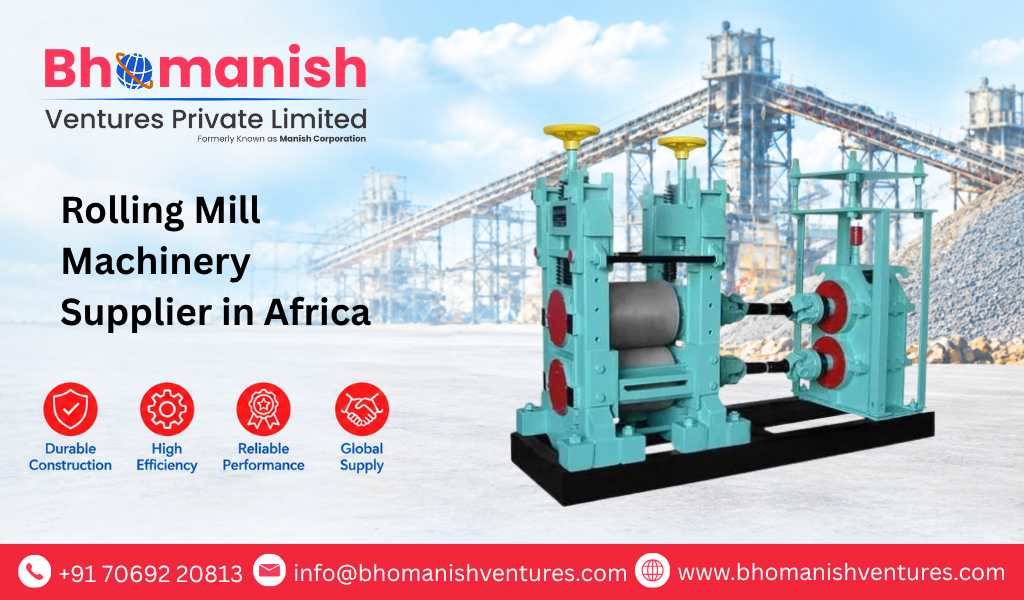
Rolling mill machinery is industrial equipment used to reduce the thickness or modify the cross-sectional shape of metal by passing it between rotating rolls. Depending on the production process, different arrangements can be used for producing bars, rods, sheets, strips, sections, and other rolled products.
A typical rolling operation involves feeding heated or prepared metal into a controlled roll gap. The rolls apply pressure while rotating, progressively changing the material's dimensions. The exact configuration depends on factors such as material type, product geometry, required output, and production sequence.
When selecting Rolling Mill Machinery in Africa, buyers should therefore focus on the complete production requirement rather than choosing equipment based only on machine size or quoted price.
Materials and Technical Considerations
Material handling and rolling conditions have a direct influence on equipment selection. A buyer should clearly identify the material being processed, its incoming dimensions, desired finished dimensions, production volume, and required product consistency.
The technical discussion should also consider:
- Roll arrangement and suitable roll configuration
- Incoming and finished material dimensions
- Required production capacity
- Drive and power requirements
- Line layout and available installation space
- Material feeding and discharge arrangements
- Cooling or temperature-management requirements where applicable
- Automation and control requirements
- Spare parts and maintenance accessibility
A knowledgeable Rolling Mill Machinery Manufacturer should review these requirements before recommending a configuration. This helps avoid purchasing equipment that may not integrate properly with the rest of the production line.
Key Features and Benefits Buyers Should Evaluate
The value of rolling equipment is not determined by one specification. Buyers should examine how the machinery fits into their complete manufacturing process.
Depending on the application, useful features may include controlled rolling operation, robust mechanical construction, accessible maintenance points, suitable drive arrangements, and compatibility with the required production workflow.
For businesses searching for the Best Rolling Mill Machinery Supplier in Africa, it is useful to compare suppliers based on documented capabilities, customization approach, technical communication, after-sales support, and ability to understand the actual application.
Equipment should also be evaluated for operational practicality. Easy access to components, clear operating procedures, suitable safety provisions, and availability of replacement parts can influence long-term maintenance requirements.
Industry Applications and Buyer Requirements
Rolling mills can serve different segments of the metal-processing industry. Applications may include steel bar production, structural sections, wire and rod processing, strip-related operations, and other metal forming requirements.
For example, a construction-steel producer may have different requirements from a facility producing smaller finished sections. Similarly, a buyer expanding an existing plant may need machinery that integrates with installed equipment rather than an entirely independent line.
Common buyer requirements include:
- New production-line installation
- Capacity expansion
- Replacement of outdated equipment
- Machinery for a specific rolled product
- Integration with existing material-handling systems
- Project-specific equipment configurations
This is why searches such as Rolling Mill Machinery Supplier & Exporter in Africa should lead to a technical discussion about the project rather than a price-only comparison.
How to Choose the Right Supplier and Understand Price
Before contacting a Rolling Mill Machinery Supplier Near me, prepare basic project information. This can include the material, input size, finished product dimensions, expected production volume, available utilities, plant layout, and whether the requirement is for a complete line or selected machinery.
When comparing Rolling Mill Machinery Price in Africa, remember that quotations can vary according to machine configuration, automation level, production requirements, auxiliary equipment, installation scope, transportation, and other project-specific factors. A lower initial quotation may not represent the same equipment scope as another offer.
Buyers searching Buy Rolling Mill Machinery in Africa should request a clearly defined quotation that identifies the machinery included, technical scope, commercial terms, delivery expectations, and any exclusions. For used or surplus equipment, additional checks concerning condition, history, compatibility, and availability of replacement components may also be necessary.
Supply, Maintenance and Long-Term Performance
For international industrial machinery procurement, supply planning should be handled according to the actual project and agreed commercial terms. Buyers considering a Rolling Mill Machinery Supplier & Exporter in Africa should clarify packaging, transportation responsibilities, documentation, installation support, and commissioning expectations where applicable.
Maintenance should begin with routine inspection rather than waiting for production problems. Operators can monitor components for unusual wear, vibration, alignment issues, lubrication requirements, and other signs of deterioration according to the equipment manufacturer's maintenance instructions.
Companies planning to Buy Rolling Mill Machinery for Sale in Africa should also consider the availability of technical documentation and replacement parts. A machine that is suitable for today's production target should ideally remain serviceable as the plant's requirements develop.
Frequently Asked Questions
1. What should I provide to a rolling mill machinery supplier?
Provide the material type, input and finished dimensions, expected production requirements, product type, plant information, and any existing machinery that the new equipment must connect with.
2. How is rolling mill machinery selected?
Selection depends on the material, product dimensions, production objectives, line configuration, operating conditions, available utilities, and the level of automation required.
3. Is rolling mill machinery available for different metal products?
Yes, rolling equipment can be configured for different rolling applications. The appropriate arrangement depends on the product geometry, material, and manufacturing process.
4. What affects rolling mill machinery price in Africa?
Pricing can depend on equipment configuration, capacity requirements, automation, auxiliary systems, transportation, installation scope, and project-specific technical requirements.
5. Should I buy a complete rolling mill line or individual machinery?
That depends on the project. A new plant may require a broader production system, while an operating facility may only need specific equipment for expansion or replacement.
6. How can I evaluate a rolling mill machinery supplier?
Compare technical understanding, equipment scope, customization capabilities, documentation, communication, service arrangements, delivery terms, and suitability for your specific production requirement.
7. Can Bhomanish Ventures Private Limited help with project-specific requirements?
Bhomanish Ventures Private Limited can discuss the intended application and project requirements so that the appropriate machinery scope can be considered before procurement.
Tags : Rolling Mill Machinery Supplier in Africa, Top Rolling Mill Machinery Supplier in Africa, Best Rolling Mill Machinery Supplier in Africa, Rolling Mill Machinery Supplier, Rolling Mill Machinery Manufacturer, Rolling Mill Machinery Supplier Near me, Rolling Mill Machinery in Africa, Rolling Mill Machinery Supplier & Exporter in Africa, Rolling Mill Machinery Price in Africa, Buy Rolling Mill Machinery in Africa, Buy Rolling Mill Machinery for Sale in Africa, Rolling Mill Machinery Supplier in Johannesburg, Rolling Mill Machinery Supplier in Durban, Rolling Mill Machinery Supplier in Lagos, Rolling Mill Machinery Supplier in Cairo, Rolling Mill Machinery Supplier in Alexandria, Rolling Mill Machinery Supplier in Accra, Rolling Mill Machinery Supplier in Nairobi, Rolling Mill Machinery Supplier in Tunis.