

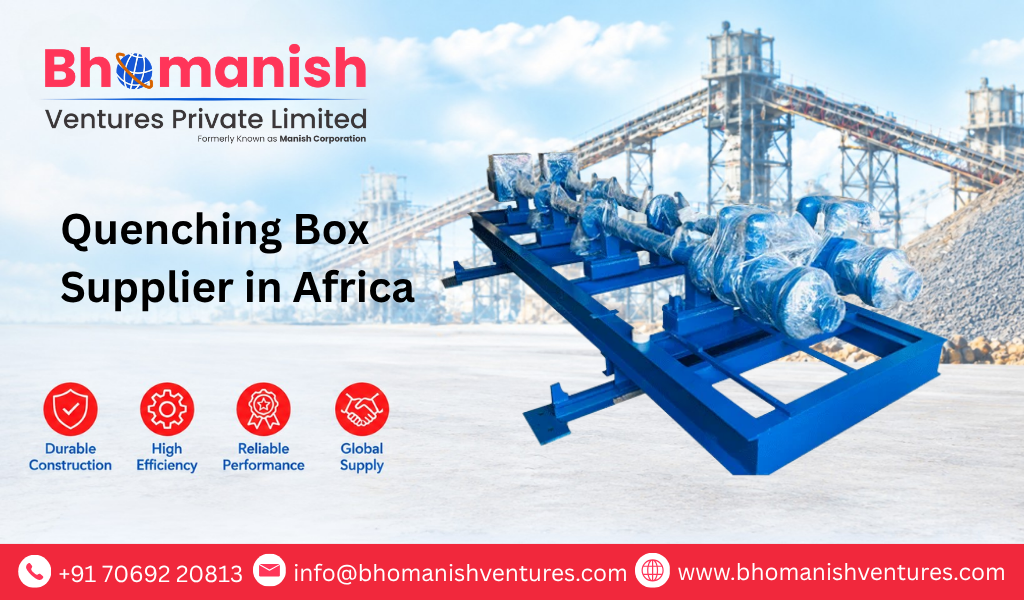
Quenching Box Supplier in Africa – Technical Guide for Industrial Buyers
Industrial heat-treatment operations require controlled handling of heated components to achieve consistent cooling, dimensional stability, and repeatable production results. A properly designed quenching box provides a practical way to hold, transfer, and immerse or cool hot components during heat-treatment processes. For buyers evaluating a Quenching Box Supplier in Africa, the important considerations go beyond price. Construction material, box geometry, load handling, compatibility with the quenching medium, and operating environment all influence suitability.
Bhomanish Ventures Private Limited supports industrial buyers looking for application-focused equipment and fabrication solutions. Rather than selecting a quenching box only from a standard description, buyers should first understand their component dimensions, loading method, heat-treatment process, and handling requirements.
What Is a Quenching Box and How Does It Work?
A quenching box is a fabricated industrial container used for handling components during controlled quenching or heat-treatment operations. The box can be designed around the shape and quantity of components being processed, allowing operators to move batches safely and consistently.
In a typical process, heated components are loaded into the box or positioned using suitable handling equipment. The box is then moved to the designated quenching area, where the components are exposed to the required cooling medium or transferred for the next stage of treatment.
The exact design depends on the process. Therefore, a Quenching Box Manufacturer should consider loading arrangement, component geometry, working temperature, lifting method, drainage requirements, and repeated thermal exposure before finalizing the construction.
Material and Technical Considerations
Material selection is one of the most important discussions when purchasing a quenching box. The box may experience repeated heating, cooling, mechanical loading, and contact with process media. The selected material should therefore correspond to the application's temperature and mechanical requirements.
Fabrication considerations can include:
- Plate thickness according to the intended load and structure
- Reinforcement around lifting or handling points
- Suitable welding and fabrication practices
- Drainage or perforation requirements where applicable
- Compatibility with the intended quenching medium
- Internal dimensions based on component size
- Easy loading and unloading arrangements
- Surface treatment appropriate to the operating environment
For buyers comparing a Quenching Box Supplier, technical drawings and application information can help avoid purchasing a box that is unsuitable for the actual process. A customized design may also be appropriate when components have unusual shapes or when the existing furnace and material-handling arrangement imposes dimensional restrictions.
Key Features and Industrial Benefits
A well-planned quenching box can simplify batch handling and improve workflow consistency. Instead of individually moving hot components, operators can handle groups of parts using an appropriate lifting or transfer arrangement.
Potential benefits include:
- Organized batch handling
- Easier movement of heated components
- Adaptability to different component sizes
- Robust construction for repeated industrial use
- Better integration with material-handling systems
- Simplified loading and unloading
- Application-specific fabrication
For companies searching for a Top Quenching Box Supplier in Africa, the useful question is not simply whether a supplier offers the product, but whether the supplier can understand the process and translate operational requirements into an appropriate fabrication design.
Industry-Wise Applications
Quenching boxes can be relevant wherever heat-treated metal components need organized handling. Their application depends on the customer's production process rather than a single industry.
Typical applications may include:
- Forging operations: Handling heated forged components before or during cooling stages.
- Automotive component production: Supporting batch movement of selected heat-treated parts.
- General engineering: Handling fabricated or machined steel components requiring controlled processing.
- Fastener manufacturing: Managing batches of components during heat-treatment workflows.
- Tool and die production: Supporting handling of suitable heat-treated tooling components.
- Metal-processing facilities: Integrating component movement with furnace and cooling operations.
A Best Quenching Box Supplier in Africa should be able to discuss these differences rather than assuming that one box configuration will suit every application.
Common Buyer Problems and Selection Guide
Buyers commonly face problems such as insufficient capacity, unsuitable dimensions, difficult loading, excessive manual handling, or a box design that does not match their furnace or cooling arrangement. These issues can often be reduced by preparing technical information before requesting a quotation.
Before choosing a Quenching Box Supplier Near me, buyers should provide:
- Component dimensions and approximate weight.
- Number of components handled per batch.
- Required internal box dimensions.
- Loading and unloading method.
- Furnace or heating-equipment dimensions where relevant.
- Intended quenching medium and process conditions.
- Available lifting equipment.
- Required quantity and expected operating frequency.
If the requirement involves international procurement, buyers can discuss documentation, packing, delivery arrangements, and commercial terms with the supplier. For customers considering Buy Quenching Box in Africa, the final selection should be based on technical compatibility rather than price alone.
Performance, Maintenance and Buying Considerations
Routine inspection is important for equipment exposed to repeated thermal and mechanical loads. Operators should periodically check welds, lifting points, handles, reinforcement members, distortion, corrosion, and other visible signs of wear. The inspection frequency should reflect the actual operating environment and applicable workplace procedures.
When comparing Quenching Box Price in Africa, buyers should consider the complete requirement, including material selection, dimensions, fabrication complexity, lifting provisions, finishing, quantity, packaging, and transportation. A lower initial quotation may not represent the same specification as a purpose-designed unit.
For businesses seeking a Quenching Box Supplier & Exporter in Africa, it is useful to request drawings, material details, dimensions, photographs or references of comparable fabrication where available, and a clearly defined quotation. Bhomanish Ventures Private Limited can be approached for requirements where the quenching box needs to be evaluated according to the customer's process and handling conditions.
Frequently Asked Questions
1. What is a quenching box used for?
It is used for organized handling and movement of components during suitable heat-treatment and quenching operations.
2. Can a quenching box be customized?
Yes. Dimensions, loading arrangements, reinforcement, lifting provisions, and other fabrication details can be considered according to the application.
3. What information should I provide before ordering?
Component dimensions, weight, batch quantity, handling method, process conditions, and available furnace or cooling-area dimensions are useful starting information.
4. Is a quenching box suitable for every quenching process?
Not necessarily. The design must be evaluated against the component, process temperature, cooling medium, loading arrangement, and material requirements.
5. How can I compare suppliers effectively?
Compare technical understanding, fabrication details, material suitability, customization capability, documentation, and commercial terms rather than comparing price alone.
6. Can I request a quotation for a quenching box?
Yes. Buyers can provide their component and process requirements to obtain a quotation based on the required configuration.
7. What should I consider before I Buy Quenching Box for Sale in Africa?
Confirm the box dimensions, load requirements, handling method, operating conditions, material compatibility, maintenance expectations, and delivery requirements before placing an order.
Tags : Quenching Box Supplier in Africa, Top Quenching Box Supplier in Africa, Best Quenching Box Supplier in Africa, Quenching Box Supplier, Quenching Box Manufacturer, Quenching Box Supplier Near me, Quenching Box in Africa, Quenching Box Supplier & Exporter in Africa, Quenching Box Price in Africa, Buy Quenching Box in Africa, Buy Quenching Box for Sale in Africa, Quenching Box Supplier in Johannesburg, Quenching Box Supplier in Durban, Quenching Box Supplier in Lagos, Quenching Box Supplier in Cairo, Quenching Box Supplier in Alexandria, Quenching Box Supplier in Accra, Quenching Box Supplier in Nairobi, Quenching Box Supplier in Tunis.