


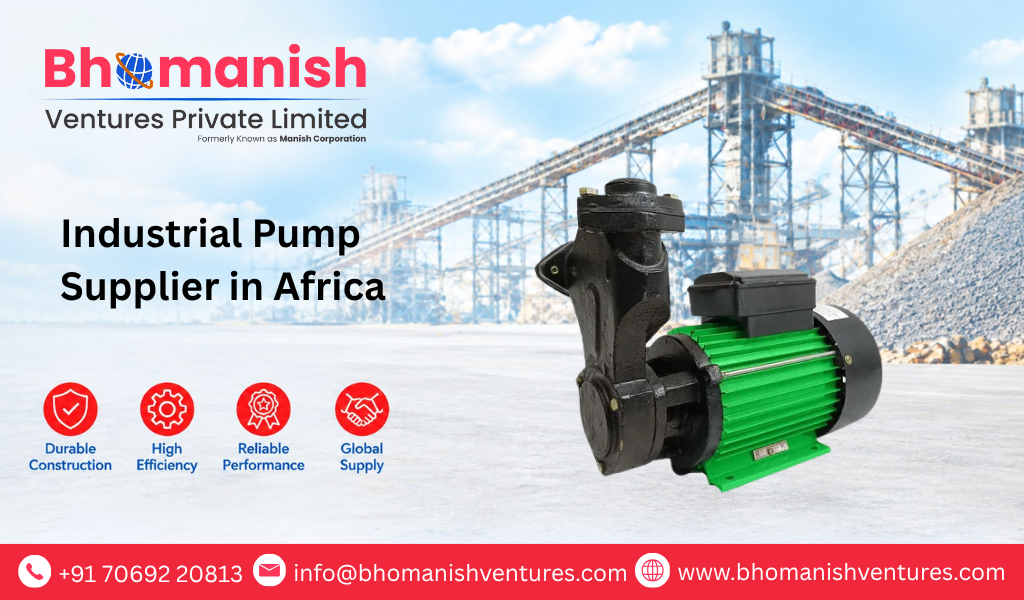
Industrial Pump Supplier in Africa
Industrial pumping requirements across Africa vary widely by industry, fluid characteristics, operating conditions, and site infrastructure. Mining operations may need dependable slurry handling, while chemical plants, water-treatment facilities, food-processing units, and manufacturing plants require pumps selected for very different duties. For buyers comparing an Industrial Pump Supplier in Africa, the right approach is therefore to evaluate application suitability rather than choosing equipment based only on price or general specifications.
Bhomanish Ventures Private Limited supports industrial buyers by helping them identify pump solutions according to process requirements, material compatibility, flow needs, installation conditions, and maintenance considerations. Whether the requirement involves process water, chemicals, wastewater, or other industrial fluids, selecting the appropriate pump configuration can contribute to consistent operation and easier maintenance.
What Is an Industrial Pump and How Does It Work?
An industrial pump is mechanical equipment designed to move fluids from one location to another within a process, utility, storage, or treatment system. Depending on the application, pumps can be selected in different designs and configurations.
A typical pump receives mechanical energy through an electric motor or another suitable drive. The pumping mechanism transfers this energy to the fluid, creating the pressure or flow required for movement through pipelines and process equipment. Pump performance depends on factors such as fluid properties, system resistance, suction conditions, required flow, and discharge pressure.
When evaluating an Industrial Pump in Africa, buyers should first define the actual duty rather than selecting a model from a catalogue based on size alone.
Material and Technical Considerations
Material selection is particularly important when pumping corrosive, abrasive, contaminated, or chemically active fluids. Depending on the application, pump construction may involve suitable grades of metal, elastomers, coatings, or other compatible materials.
Before requesting an Industrial Pump Supplier, buyers should prepare information such as:
- Fluid being handled and its approximate temperature
- Required flow rate
- Required discharge pressure or head
- Suction arrangement and available suction conditions
- Fluid viscosity and presence of solids
- Corrosive or abrasive characteristics
- Operating hours and duty cycle
- Available electrical supply
- Installation environment and space limitations
For slurry or solids-containing applications, wear resistance and appropriate hydraulic design become important considerations. Chemical applications require careful compatibility assessment between the fluid and wetted components. For water and utility services, reliability, serviceability, and efficient operation may receive greater attention.
Key Features and Buyer Benefits
A suitable industrial pumping solution should match the process rather than simply offering the highest capacity. Buyers commonly look for dependable operation, manageable maintenance, appropriate construction materials, and compatibility with existing plant systems.
Working with an experienced Industrial Pump Manufacturer or supplier can also help buyers clarify whether the selected pump is appropriate for continuous or intermittent service, whether auxiliary components are required, and how the pump should integrate with existing pipelines and controls.
Bhomanish Ventures Private Limited focuses on application-oriented discussions so customers can communicate their actual operating requirements before finalizing a pumping solution. This is especially useful when replacing an existing pump, expanding a production line, or developing a new industrial installation.
Industrial Applications Across Africa
Industrial pumps can serve numerous sectors, but the required pump arrangement differs substantially between applications.
Mining and mineral processing: Pumping duties may involve process water, slurry, drainage, and material-processing circuits where abrasive conditions can affect component life.
Water and wastewater: Pumps are commonly used for water transfer, circulation, treatment processes, and wastewater movement. System design should consider solids, operating cycles, and the required flow conditions.
Chemical processing: Fluid compatibility is a major consideration. Pump materials and sealing arrangements should be selected according to the chemical being handled.
Manufacturing: Industrial facilities may require pumps for cooling water, process fluids, utility systems, and liquid transfer between tanks or production stages.
Food and beverage processing: Hygienic requirements, cleanability, fluid characteristics, and applicable process requirements can influence pump selection.
These varied applications demonstrate why an Industrial Pump Supplier & Exporter in Africa should evaluate the intended duty before recommending equipment.
Common Buyer Problems and How to Choose
One common purchasing problem is selecting a pump according to pipe size or motor power without adequately defining the actual operating point. Another is overlooking fluid characteristics, resulting in unsuitable materials or premature component problems.
Buyers searching for an Industrial Pump Supplier Near me may also focus heavily on immediate availability. While delivery considerations matter, technical compatibility should remain central to the purchase decision.
Before choosing a supplier, ask:
- Can the supplier understand the complete pumping application?
- Can the proposed materials handle the intended fluid?
- Does the pump match the required flow and pressure conditions?
- Is the design suitable for the expected operating cycle?
- Are installation and maintenance requirements clearly explained?
- Can replacement parts and technical assistance be arranged when required?
For customers comparing Industrial Pump Price in Africa, the purchase cost should be considered alongside installation requirements, maintenance, expected service conditions, and the consequences of unsuitable equipment. A lower initial quotation does not necessarily represent the same overall solution as a technically matched pump.
Buying, Supply and Maintenance Considerations
When planning to Buy Industrial Pump in Africa, provide the supplier with accurate process information and existing system details wherever available. This enables more meaningful equipment selection and reduces the risk of mismatched capacity.
For replacement projects, information from the existing pump nameplate, operating history, pipeline arrangement, and process conditions can be particularly useful. For new installations, a basic process description and required duty points can help establish the appropriate equipment configuration.
Buyers considering an Industrial Pump for Sale in Africa should also discuss inspection, installation, commissioning, operating procedures, spare components, and routine maintenance requirements with the supplier. Regular inspection of seals, bearings, connections, valves, and other applicable components can help identify developing issues before they interrupt operations. Actual maintenance intervals should follow the pump design, operating environment, manufacturer guidance, and site conditions.
Frequently Asked Questions
1. What should I provide when contacting an Industrial Pump Supplier in Africa?
Provide the fluid type, required flow, pressure or head, temperature, solids content if applicable, operating hours, suction conditions, and available power information.
2. How do I select the right industrial pump?
Start with the application's required flow and pressure conditions, then consider fluid properties, material compatibility, installation arrangement, operating cycle, and maintenance requirements.
3. Does Industrial Pump Price in Africa depend only on pump size?
No. Pricing can be influenced by pump design, materials, configuration, drive arrangement, accessories, application requirements, and supply conditions.
4. Can industrial pumps be used for chemical applications?
They can be, provided the selected pump construction and wetted materials are compatible with the specific chemical, concentration, temperature, and operating conditions.
5. What is the difference between an Industrial Pump Manufacturer and supplier?
A manufacturer produces the equipment, while a supplier may provide equipment from one or more manufacturers and assist with sourcing, application selection, and supply.
6. What should I check before buying an industrial pump?
Check the required duty point, fluid compatibility, construction materials, installation conditions, operating cycle, maintenance requirements, documentation, and supplier support.
7. Can Bhomanish Ventures Private Limited help with industrial pump requirements?
Bhomanish Ventures Private Limited can discuss the application and equipment requirements with buyers so that the proposed pumping solution can be evaluated according to the intended industrial service.
Tags : Industrial Pump Supplier in Africa, Top Industrial Pump Supplier in Africa, Best Industrial Pump Supplier in Africa, Industrial Pump Supplier, Industrial Pump Manufacturer, Industrial Pump Supplier Near me, Industrial Pump in Africa, Industrial Pump Supplier & Exporter in Africa, Industrial Pump Price in Africa, Buy Industrial Pump in Africa, Buy Industrial Pump for Sale in Africa, Industrial Pump Supplier in Johannesburg, Industrial Pump Supplier in Durban, Industrial Pump Supplier in Lagos, Industrial Pump Supplier in Cairo, Industrial Pump Supplier in Alexandria, Industrial Pump Supplier in Accra, Industrial Pump Supplier in Nairobi, Industrial Pump Supplier in Tunis.