

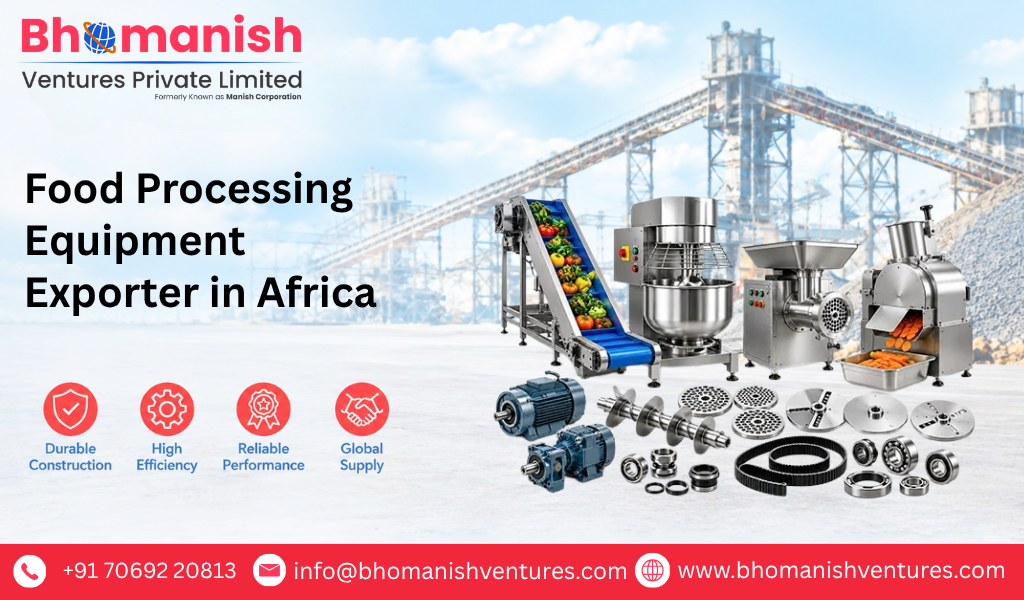
Food Processing Equipment Exporter in Africa
Introduction
Africa’s food processing sector is expanding across several industries, including grain milling, edible oil production, dairy processing, fruit and vegetable preservation, bakery manufacturing, and packaged food production. As food businesses work to improve productivity, maintain product quality, and reduce processing losses, choosing suitable machinery has become an important part of their investment decisions. Bhomanish Ventures Private Limited supports industrial buyers seeking suitable food processing equipment for different production requirements.
Selecting a Food Processing Equipment Exporter in Africa involves more than comparing prices. Buyers need to consider the type of food being processed, production capacity, material compatibility, cleaning requirements, available utilities, and the level of technical support offered by the supplier. These factors help businesses identify equipment that fits their operations and long-term objectives.
Whether establishing a new processing facility or upgrading an existing production line, businesses searching for a Food Processing Equipment Manufacturer should evaluate equipment suitability, documentation, and supplier communication before placing an order.
What Is Food Processing Equipment and How Does It Work?
Food processing equipment includes machinery used to clean, sort, peel, cut, grind, mix, heat, cool, dry, fill, and package food products. Depending on the application, a processing facility may use individual machines or combine several machines into a coordinated production line.
For example, a grain processing unit may require cleaning, grading, grinding, and material-handling equipment. A fruit processing facility may need washing, cutting, pulping, and packaging machinery. Dairy operations may require equipment designed for controlled heating, cooling, transfer, and hygienic cleaning.
Businesses evaluating Food Processing Equipment in Africa should first identify the complete production workflow. The equipment must suit the product's physical properties, moisture content, processing temperature, and intended output.
Bhomanish Ventures Private Limited can be considered by buyers assessing machinery requirements for food-related industrial projects. Before finalizing a configuration, buyers should confirm the available equipment models, application suitability, and technical specifications directly with the supplier.
Key Features, Materials, and Technical Considerations
Food processing machinery must be selected according to its working environment and the characteristics of the product. Equipment used for dry grains may have different material and cleaning requirements from machinery handling liquids, oils, dairy products, or acidic fruit preparations.
Important considerations include:
- Food-contact materials: Confirm that surfaces contacting food are suitable for the product, cleaning chemicals, temperature, and applicable food-safety requirements.
- Production capacity: Match the machine's rated throughput with expected production volumes, operating hours, and future expansion plans.
- Cleaning and hygiene: Examine accessibility, removable components, drainage arrangements, and cleaning procedures to support hygienic operation.
- Automation and controls: Determine whether manual, semi-automatic, or automated operation is appropriate for the available workforce and production process.
- Power and utilities: Verify electrical supply, water availability, compressed air requirements, heating needs, and other site-specific conditions.
- Installation requirements: Check floor space, equipment dimensions, foundation requirements, operator access, and material-flow arrangements.
These factors are particularly relevant when comparing offers from a Food Processing Equipment Supplier in Africa. A machine with a lower initial purchase price may not provide the best overall value if it requires extensive modifications or creates avoidable operating difficulties.
Industry-Wise Applications and Common Buyer Requirements
Food processing machinery serves a broad range of commercial and industrial applications. Understanding the intended use helps buyers specify the correct equipment instead of investing in unnecessary features.
In grain and cereal processing, machinery supports cleaning, grading, milling, and handling. Oilseed processing facilities may require equipment for seed preparation, pressing, filtration, and associated material movement. Fruit and vegetable processors may need washing, slicing, pulping, drying, or packaging solutions.
Dairy businesses must pay particular attention to hygienic design and temperature management. Bakeries and snack manufacturers may require mixing, forming, baking, cooling, and packaging equipment. Meat and seafood processing operations have additional requirements concerning sanitation, temperature control, and applicable food-safety regulations.
Companies searching for a Food Processing Equipment Exporter should clearly explain their product type, planned output, available utilities, and operating conditions. Common buyer challenges include inconsistent product quality, production bottlenecks, high material wastage, difficult cleaning procedures, and machinery that does not integrate properly with existing equipment.
A well-defined requirement helps Bhomanish Ventures Private Limited understand the buyer's application and allows both parties to assess the suitability of the proposed machinery.
How to Choose the Right Equipment and Understand Pricing
The process of selecting machinery should begin with a clear production requirement rather than a price comparison alone. Businesses looking for the Best Food Processing Equipment Exporter in Africa should evaluate documented capabilities, equipment suitability, commercial terms, and the availability of after-sales assistance.
Use the following buying checklist:
- Define the product: Specify the raw material, final product, processing method, and quality requirements.
- Estimate capacity: Calculate the required output per hour or day and account for seasonal demand where applicable.
- Compare technical offers: Review machine dimensions, rated capacity, construction materials, power requirements, and included accessories.
- Evaluate total cost: Consider the equipment price, packaging, freight, insurance, import duties, installation, commissioning, and ongoing operating expenses.
- Confirm documentation: Request the applicable technical drawings, operating manuals, commercial invoice details, and shipping documents.
- Discuss support: Clarify warranty terms, spare-parts availability, troubleshooting arrangements, and operator training.
- Check site readiness: Ensure the destination facility can accommodate the machinery and provide the required utilities.
The Food Processing Equipment Price in Africa varies according to machinery type, production capacity, construction materials, automation level, configuration, and delivery destination. Buyers should request a detailed quotation based on their actual requirements.
Businesses planning to Buy Food Processing Equipment in Africa should also confirm import procedures, applicable standards, customs documentation, and local installation arrangements before making a financial commitment.
Supply, Export, and Long-Term Performance Considerations
International equipment procurement requires coordination between the buyer and supplier. Before confirming an order, businesses should establish the delivery scope, packaging method, shipment responsibilities, payment schedule, documentation requirements, and expected dispatch timeline.
Companies searching for a Top Food Processing Equipment Exporter in Africa should verify the supplier's actual export capabilities, destination-country coverage, and experience with the required equipment. Export suitability should be established through direct confirmation rather than assumed from general product descriptions.
For buyers searching Food Processing Equipment Exporter Near me, proximity may be useful for site visits, inspections, and service coordination. However, technical suitability, verified references, clear contractual terms, and support arrangements remain important when evaluating local and international suppliers.
Long-term performance depends on correct installation, trained operators, regular inspection, and adherence to the manufacturer's maintenance instructions. Cleaning schedules, lubrication where applicable, replacement of worn components, and monitoring of operating conditions can help reduce unexpected downtime. Equipment should always be maintained according to its design and the food-safety requirements of the facility.
Bhomanish Ventures Private Limited can be contacted to discuss equipment requirements, intended applications, and the commercial information needed to assess a suitable supply arrangement.
Frequently Asked Questions
1. What equipment is needed to start a food processing business?
The required machinery depends on the product and production method. A grain unit, bakery, dairy facility, and fruit processing plant each require different combinations of processing, handling, and packaging equipment.
2. How can I compare food processing equipment suppliers?
Compare technical specifications, product suitability, quoted costs, warranty conditions, documentation, delivery terms, spare-parts support, and relevant customer references.
3. What affects food processing equipment prices?
Prices depend on machine type, capacity, construction materials, automation, accessories, customization, shipping, installation, and destination-specific import charges.
4. Can food processing equipment be customized?
Some machinery can be configured to meet specific capacity, product-handling, layout, or automation requirements. Customization options must be confirmed with the equipment supplier.
5. What should African buyers verify before importing machinery?
Buyers should check applicable local regulations, electrical compatibility, import permits where required, customs duties, shipping documents, installation arrangements, and after-sales support.
6. How can I request a quotation from Bhomanish Ventures Private Limited?
Share your product type, required processing capacity, intended application, installation location, utility details, and any preferred technical specifications. Request a written quotation that clearly identifies the equipment and included services.
7. Is it better to buy a complete processing line or individual machines?
A complete line may simplify coordination between processing stages, while individual machines can suit phased investments or existing facilities. The decision depends on the production workflow, available budget, integration requirements, and expansion plans.
Conclusion
Choosing food processing machinery requires a practical understanding of product requirements, operating conditions, equipment performance, and total procurement costs. Bhomanish Ventures Private Limited provides a point of contact for businesses exploring equipment requirements and potential supply arrangements. By defining technical needs, checking supplier documentation, and comparing complete commercial offers, buyers can make informed decisions for their food processing projects in Africa.
Tags : Food Processing Equipment Exporter in Africa, Top Food Processing Equipment Exporter in Africa, Best Food Processing Equipment Exporter in Africa, Food Processing Equipment Exporter, Food Processing Equipment Manufacturer, Food Processing Equipment Exporter Near me, Food Processing Equipment in Africa, Food Processing Equipment Supplier in Africa, Food Processing Equipment Price in Africa, Buy Food Processing Equipment in Africa, Buy Food Processing Equipment for Sale in Africa, Food Processing Equipment Exporter in Johannesburg, Food Processing Equipment Exporter in Durban, Food Processing Equipment Exporter in Lagos, Food Processing Equipment Exporter in Cairo, Food Processing Equipment Exporter in Alexandria, Food Processing Equipment Exporter in Accra, Food Processing Equipment Exporter in Nairobi, Food Processing Equipment Exporter in Tunis.