

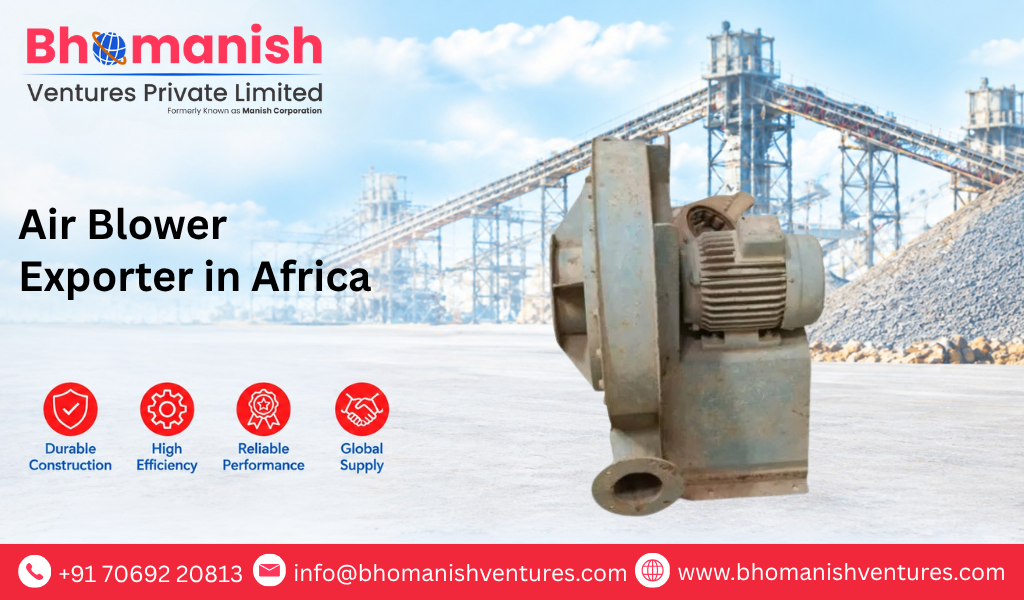
Air Blower Exporter in Africa | Bhomanish Ventures Private Limited
Choosing the Right Air Blower for Industrial Requirements
Industrial processes often require a controlled flow of air for combustion, aeration, cooling, pneumatic conveying, ventilation, drying, or material handling. Selecting the right blower is therefore not simply a matter of comparing prices. Buyers need to consider airflow requirements, pressure, operating conditions, installation space, energy consumption, maintenance access, and application-specific performance.
For businesses searching for an Air Blower Exporter in Africa, the purchasing decision should begin with the actual operating requirement rather than the product name alone. Bhomanish Ventures Private Limited supports industrial buyers by helping them identify suitable blower configurations according to their process requirements and application conditions.
The company can serve buyers looking for an Air Blower Manufacturer, supplier, or export-oriented source while keeping product selection focused on practical industrial requirements.
What Is an Air Blower and How Does It Work?
An air blower is a mechanical device designed to move air or gas from one location to another while generating a required level of pressure or airflow. Unlike applications where simple ventilation is sufficient, industrial systems may require air to be delivered consistently against system resistance.
The basic operating principle involves rotating impellers or other air-moving components inside a blower housing. Depending on the blower design, the rotating assembly accelerates air and converts mechanical energy into airflow and pressure. The exact performance depends on factors such as blower geometry, rotational speed, inlet conditions, system resistance, and motor arrangement.
When evaluating an Air Blower in Africa, buyers should therefore provide application information rather than requesting a blower based only on capacity or motor size.
Material and Technical Considerations
Material selection depends heavily on the environment in which the blower operates. Standard industrial installations may use appropriately selected metals for the casing, impeller, shaft, and supporting components, while demanding environments can require materials or protective treatments suitable for temperature, moisture, dust, or corrosive exposure.
Important technical considerations include:
- Required airflow or volume flow
- Required operating pressure
- Gas or air temperature
- Dust or particulate content
- Operating hours and duty cycle
- Available electrical supply
- Installation orientation and space
- Noise and vibration considerations
- Inlet and outlet connection requirements
- Maintenance accessibility
A reliable Air Blower Supplier in Africa should review these conditions before recommending a configuration. This reduces the possibility of selecting equipment that technically operates but does not perform effectively within the complete process system.
Key Benefits and Industrial Applications
The main purpose of a blower is to provide controlled air movement for a specific process. Depending on configuration and operating conditions, industrial blowers can support applications involving ventilation, combustion air, drying, cooling, aeration, pneumatic movement, and process-air circulation.
Potential application areas include:
- Manufacturing and processing plants
- Wastewater and water-treatment systems
- Chemical and process industries
- Food and beverage processing
- Cement and mineral-related operations
- Industrial furnaces and combustion systems
- Material-handling installations
- General plant ventilation
For international procurement, an Air Blower Exporter should also understand that the same blower category may have very different requirements across industries. A blower used for general ventilation should not automatically be treated as suitable for a high-resistance process-air application.
Common Buyer Problems and Requirements
One common purchasing problem is specifying a blower only by motor power. Motor rating alone does not establish whether the blower will deliver the required airflow at the actual system pressure.
Another issue is overlooking the operating environment. Dust, elevated temperatures, moisture, corrosive gases, frequent starting and stopping, or continuous operation can influence equipment selection and maintenance requirements.
Buyers comparing the Air Blower Price in Africa should therefore compare equivalent configurations rather than comparing quoted prices without reviewing technical scope. They should ask:
- What airflow is required?
- At what pressure should the blower operate?
- What material or gas is being handled?
- Is the application continuous or intermittent?
- What power supply is available?
- What are the environmental conditions?
- What installation and maintenance limitations exist?
These details provide a much more meaningful basis for procurement.
How to Select and Buy an Air Blower
Before choosing equipment, prepare a basic application specification containing airflow, pressure, temperature, operating hours, installation conditions, power availability, and connection requirements. This information allows suppliers to evaluate the requirement more accurately.
If you are planning to Buy Air Blower in Africa, request a quotation that clearly identifies the proposed configuration and relevant technical information. Buyers searching for an Air Blower Exporter Near me may also benefit from considering suppliers that can communicate clearly about application requirements and documentation.
For customers looking to Buy Air Blower for Sale in Africa, procurement should also consider spare-part availability, service requirements, packaging, transportation, and installation arrangements where applicable.
Bhomanish Ventures Private Limited can discuss the intended application before moving toward a supply recommendation, helping buyers avoid an unsuitable one-size-fits-all selection.
Maintenance, Performance and Supply Considerations
Regular inspection is important for maintaining blower performance. Maintenance requirements vary according to blower construction and operating conditions, but buyers should establish suitable inspection routines for bearings, rotating components, connections, vibration, cleanliness, and other manufacturer-defined service points.
Unexpected performance issues can sometimes originate outside the blower itself. Blocked filters, excessive system resistance, incorrect ducting, leakage, or unsuitable operating conditions can affect actual airflow. Consequently, troubleshooting should consider the complete air-handling system rather than the blower alone.
For international requirements, supply planning should account for the confirmed technical configuration, packaging, shipping documentation, destination requirements, and agreed commercial terms. Export arrangements should be confirmed according to the specific order and destination rather than assuming identical requirements for every African market.
Frequently Asked Questions
1. What information should I provide when ordering an air blower?
Provide required airflow, operating pressure, temperature, application, operating hours, power supply, installation conditions, and any special environmental requirements.
2. Does a higher motor power always mean better blower performance?
No. Blower suitability depends on the relationship between airflow, pressure, system resistance, operating conditions, and equipment design. Motor power should not be considered in isolation.
3. How can I compare Air Blower Price in Africa?
Compare technically equivalent configurations, including capacity, pressure requirements, construction, accessories, and supply scope rather than comparing price alone.
4. Can an industrial blower be used for different applications?
Some blower designs can serve multiple applications, but suitability must be confirmed against the required airflow, pressure, medium, temperature, and operating environment.
5. What should I check before buying an air blower?
Check the process requirement, airflow, pressure, temperature, installation space, electrical supply, operating cycle, maintenance requirements, and supplier documentation.
6. Is maintenance important for blower performance?
Yes. Regular inspection and maintenance can help identify issues such as contamination, abnormal vibration, component wear, or connection problems before they affect operation significantly.
7. Who can help with an industrial air blower requirement?
An experienced Air Blower Manufacturer or exporter can review the application details and help identify an appropriate configuration based on the actual operating conditions.
Tags : Air Blower Exporter in Africa, Top Air Blower Exporter in Africa, Best Air Blower Exporter in Africa, Air Blower Exporter, Air Blower Manufacturer, Air Blower Exporter Near me, Air Blower in Africa, Air Blower Supplier in Africa, Air Blower Price in Africa, Buy Air Blower in Africa, Buy Air Blower for Sale in Africa, Air Blower Exporter in Johannesburg, Air Blower Exporter in Durban, Air Blower Exporter in Lagos, Air Blower Exporter in Cairo, Air Blower Exporter in Alexandria, Air Blower Exporter in Accra, Air Blower Exporter in Nairobi, Air Blower Exporter in Tunis.